The Venice Lido is a strip of sand about 11–12 kilometres long that closes off the lagoon from the open sea. On one side calm water and boats, on the other the Adriatic and the beaches. It is unlike any other island here: there are cars, buses, tarmac roads and cycle paths, early 20th-century villas, grand historic hotels and, at the end of summer, the red carpets of the Venice Film Festival. From the centre it takes 14 minutes by vaporetto from San Zaccaria.
People looking up the Lido usually want one of three things: a beach day without leaving Venice, the film festival, or a calmer place to stay. This page helps you decide whether it suits you, which beach to choose and how to get around once you land.
The Lido at a glance
You land at Santa Maria Elisabetta (S.M.E.), the main stop on the lagoon side. From here the Gran Viale Santa Maria Elisabetta, a tree-lined avenue of shops, bars and ice-cream parlours, crosses the island to the sea: about ten minutes on foot and you are on the Lungomare Marconi, facing the Adriatic. Everything you need is along this axis.
To the north is San Nicolò, with its church, the lighthouse at the harbour mouth and a free beach. To the south the Lido grows narrower and wilder: you pass the village of Malamocco, old and quiet, and reach Alberoni, with dunes and pine woods. Between S.M.E. and the sea lies the area of the grand hotels and the Film Festival, around the Palazzo del Cinema and the Excelsior.
The island is served by ACTV buses, included in the tourist passes. A bike, though, is almost always the better choice.
Lido beaches: free or bathing clubs
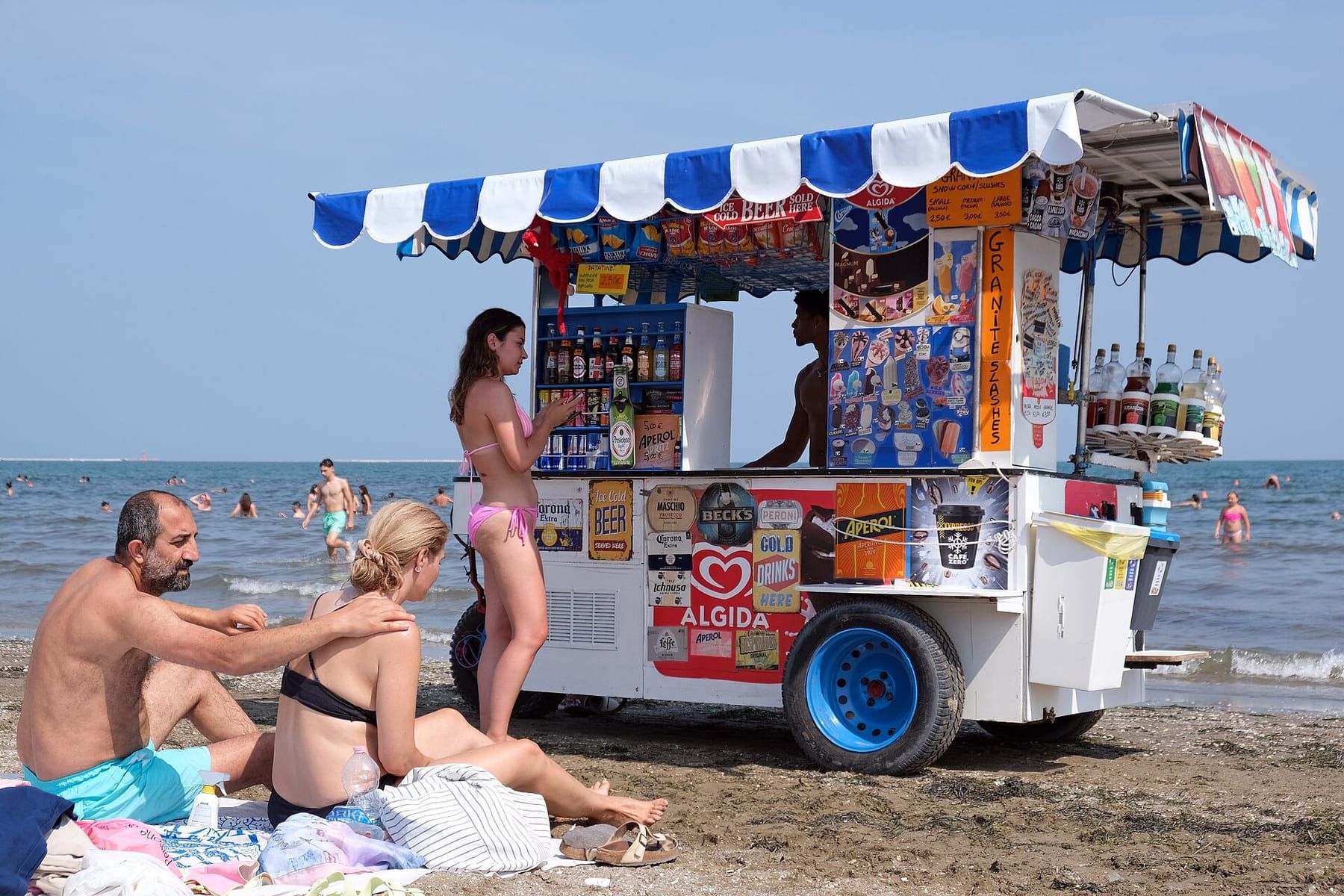
The first thing to know is that most of the beach is let out as concessions. The stabilimenti (bathing clubs) rent capanne (the Lido’s typical wooden beach cabins), umbrellas and loungers by the day or the season, with a bar, showers and facilities. Prices vary a lot from one summer to the next and between clubs, and rise at weekends in high summer: ask the club directly. They are not bookable on Tiqets.
Then there are the free public beaches (spiagge libere), where you bring your own towel and umbrella:
| Beach | Where | What it’s like | Best for |
|---|---|---|---|
| Blue Moon | End of the Gran Viale, central | The easiest from S.M.E., with bars and facilities around | Day-trippers without transport |
| San Nicolò | Northern end | Wide, quieter, near the breakwater | Cyclists looking for space |
| Alberoni | Southern end | Dunes, pine woods, WWF nature reserve | Nature and few people |
| Bathing clubs | All along the seafront | Cabins, loungers, umbrellas for rent | Families, beach holidays |
A curiosity: the word “lido”, now used all over Italy for seaside resorts, comes from here. The bathing season follows the clubs’ summer calendar; out of season the beaches stay open for walks, but the facilities close.
The Venice Film Festival
The Biennale’s Venice International Film Festival (Mostra Internazionale d’Arte Cinematografica) is the oldest film festival in the world. The first edition ran from 6 to 21 August 1932 on the terrace of the Hotel Excelsior; it has been annual since 1935. The Palazzo del Cinema on the seafront opened in 1937, designed by Luigi Quagliata, and the Golden Lion has been awarded since 1949.
Each year the festival takes place between late August and early September, for about eleven days. During that time the stretch of seafront between the Palazzo del Cinema and the Excelsior becomes a film set: red carpets, photographers, fans waiting behind the barriers. The public can buy tickets for screenings too, sold on the Biennale website according to the calendar announced before each edition. If you want to stay on the Lido during the festival, book well ahead: hotels fill up months in advance.
Liberty villas and grand hotels
Between the late 19th and early 20th centuries the Lido became one of the most elegant seaside resorts in Europe. What remains are the Liberty-style villas (Italian Art Nouveau), with wrought iron, ceramics and turrets, along the Gran Viale and its side streets, and three emblematic hotels:
- Grand Hotel des Bains (opened 1900): the neoclassical building on the seafront made famous by Thomas Mann’s Death in Venice. Seen from outside.
- Hungaria Palace (1907), now the Grand Hotel Ausonia & Hungaria: its façade is covered in majolica tiles with Renaissance motifs reinterpreted in Liberty style, one of the most photographed buildings on the island, halfway along the Gran Viale.
- Hotel Excelsior (1908): Moorish in style, with domes and arches, right next to the Palazzo del Cinema.
A walk from S.M.E. along the Gran Viale and the seafront to the Excelsior takes in all of them.
By bike to Alberoni
The Lido is flat and long: by bike you can ride its full length in a morning, with stops. There are bike rental shops near the Santa Maria Elisabetta landing, with regular bikes, tandems and family pedal carts. Remember that cycling is not allowed in the historic centre, so you pick up and drop off the bike on the Lido. On ACTV boats a bike costs €1.50 and is allowed only on some lines and vessels; folding bikes travel free.
The classic route heads south: from the Gran Viale along the shore, then the road to Malamocco, a village of low houses and canals that feels more like Chioggia than Venice, and finally Alberoni at the southern tip. Here you find dunes, pine woods, a WWF reserve and the golf course. If your legs still have something left, come back along the murazzi, the stone sea walls built to hold back the Adriatic. To the north, San Nicolò is only a few minutes away.
How to get to the Lido
| From | Transport | Approximate time |
|---|---|---|
| San Marco – San Zaccaria | ACTV line 14 (also 1, 5.1) | about 14 minutes on the 14 |
| Station / Piazzale Roma | ACTV line 1 along the Grand Canal, or 5.1/5.2 | about an hour on line 1 |
| Tronchetto (by car) | ACTV line 17, car ferry to San Nicolò | about 35 minutes, roughly every 50 minutes |
| Marco Polo Airport | Alilaguna Blue line, Lido S.M.E. stop | see alilaguna.it |
| San Marco (water taxi) | Official fare €50 | a few minutes |
Official ACTV prices: €9.50 for 75 minutes, €25 for the 24-hour pass, which also covers the Lido and Pellestrina buses, and €16 for the return ticket designed for the beaches. For a water taxi the official fare between San Marco and Lido S.M.E. is €50, from the station or Piazzale Roma €70. All vaporetto fares are on the ACTV vaporetto page.
Access Fee: none on the Lido
The Comune’s regulation lists the Lido, with Alberoni and Malamocco, among the minor islands excluded from the Access Fee. A day spent only on the Lido therefore needs neither payment nor registration. If you arrive on a charged day and pass through the historic centre first, the historic-city rule applies to that part: details are on the Access Fee page.
Tours and experiences
You don’t need tickets for the Lido: free beaches, villas and avenues are open to all. Tiqets has no products dedicated to the island. GetYourGuide lists experiences that include it, such as guided bike rides or boat trips in the lagoon: useful if you want someone to take you to Alberoni and Malamocco and explain what you see, or if you’d rather not arrange the rental yourself.
Who the Lido is for (and who should skip it)
Worth it if:
- it’s summer and you want a beach day without leaving the lagoon;
- you are in Venice during the Film Festival;
- you like cycling and have at least half a day free;
- you are travelling with children who, after three days of museums, need some sand;
- you want a quieter place to stay, with quick connections to San Zaccaria.
Better skipped if:
- you have only one or two days and haven’t yet seen the historic centre, Murano and Burano;
- you are after the Venice of canals: the Lido is something else, closer to a seaside town.
Practical tips
- Out on the 14, back on line 1 at sunset: the return along the Grand Canal in the late afternoon is worth the trip on its own.
- Umbrella: there is no shade on the free beaches; bring your own or take a spot at a bathing club.
- Food and water: the Gran Viale has supermarkets and bakeries, cheaper than the beach bars.
- Out of season: in autumn and winter the Lido is quiet and windy, lovely for walking on an empty beach, but many facilities close.
- Spa and wellness: if after the beach you want a day of pampering, the options in the city and lagoon are on the Venice spa and wellness page.
Combine with
- Giudecca and San Giorgio: with a 24-hour pass you can pair the Lido with Giudecca and San Giorgio, all served from San Zaccaria.
- The other islands: to compare them all, start from the lagoon islands page.
- Ideas for the day: more suggestions on the things to do in Venice page.
Frequently asked questions
How do I get to the Venice Lido?
The quickest way is line 14 from San Zaccaria, about 14 minutes to Lido S.M.E. From the station and Piazzale Roma you can take line 1, which runs the whole Grand Canal in about an hour, or the 5.1 and 5.2 circular lines; with a car you use the line 17 ferry from Tronchetto.
Are the Lido beaches free?
Partly. Much of the seafront is let to bathing clubs that rent cabins, umbrellas and loungers, but there are free public beaches: Blue Moon at the end of the Gran Viale, San Nicolò in the north and Alberoni in the south, with its dunes.
How much is the vaporetto to the Lido?
The 75-minute ACTV ticket costs €9.50 and the 24-hour pass €25, which also covers the Lido buses. ACTV also sells a dedicated beach return ticket for €16.
When is the Venice Film Festival?
The Venice International Film Festival is held every year on the Lido between late August and early September, for about eleven days. The exact dates and public ticket sales are announced on the Biennale website.
Can you cycle on the Lido?
Yes, it is the best way to get around: the island is flat and there are rental shops near the Santa Maria Elisabetta landing. On the vaporetto a bike costs €1.50 and is allowed only on some lines, while folding bikes travel free.
Do you pay the Access Fee on the Lido?
No. The Lido, including Alberoni and Malamocco, is among the islands excluded from the Access Fee. If you also pass through the historic centre on a charged day, the historic-city rule applies to that part of the day.
Is the Lido worth it if I only have a few days in Venice?
With one or two days, usually not; the historic centre, Murano and Burano come first. The Lido is worth it in summer for the sea, during the Film Festival, by bike when you have more time, or as a quieter and cheaper place to stay.