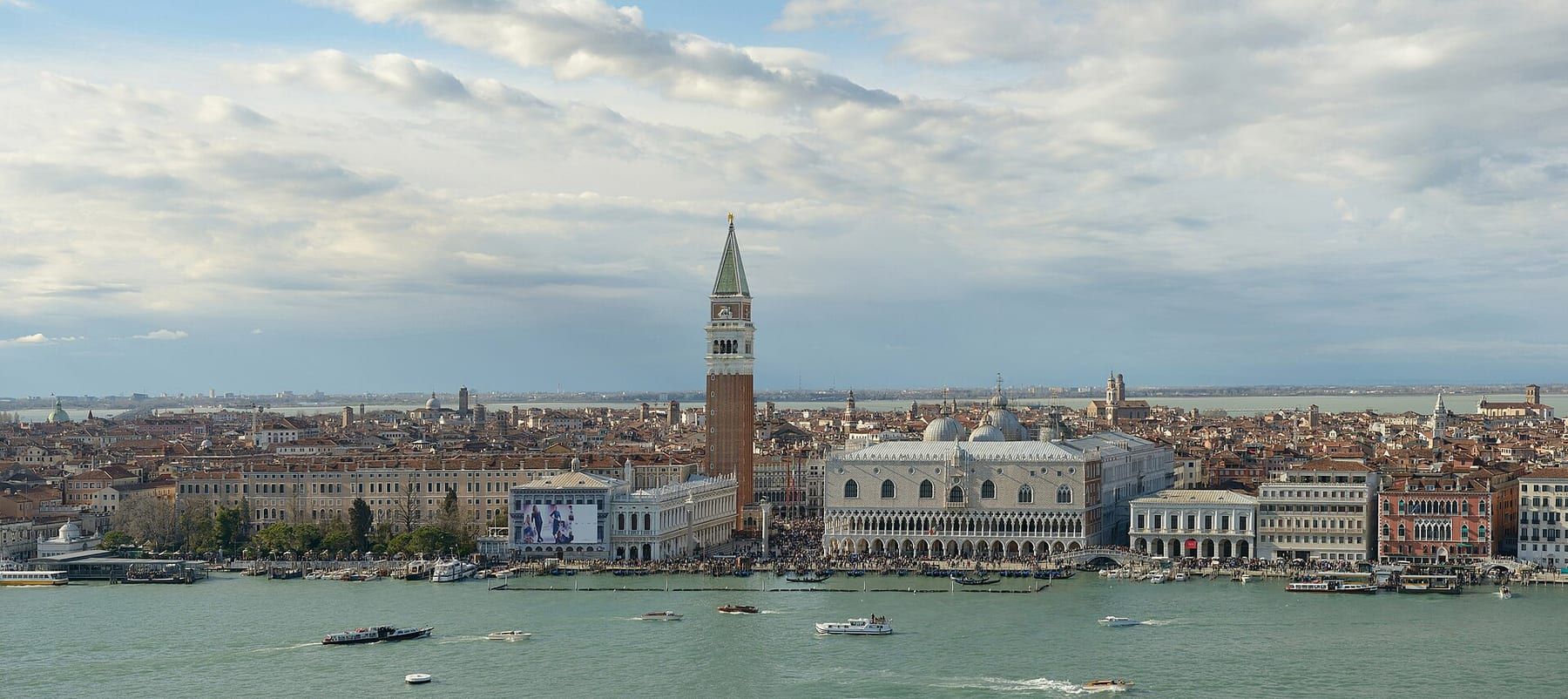
St Mark’s Square, Piazza San Marco, is the only “piazza” in Venice: every other open space in the city is called a campo. It is the drawing room overlooked by the Basilica, the Campanile, the Clock Tower and the long arcades of the Procuratie, and it opens onto the Basin through the Piazzetta, in front of the Doge’s Palace. People searching for “San Marco square Venice”, “Piazza San Marco Venice” or simply “San Marco Venice” usually want to know three things: what there is to see, how much the monuments cost to enter and which rules apply in the square. You’ll find them all here, with the official prices and the alternatives sold online.
The square itself is free and open at all hours. You pay to go inside the monuments, and each has its own ticket office: the Basilica and bell tower are run by the Procuratoria di San Marco, while the Doge’s Palace, Correr and Clock Tower belong to the Musei Civici (MUVE). Prices are those published at the time of our last update and may change.
What’s around St Mark’s Square
Stand in the middle of the square facing the Basilica and look around you.
In front of you, St Mark’s Basilica. Domes, gold-ground mosaics and, on the façade loggia, the four bronze horses: the ones outside are copies, the originals are in the Museum inside. Entry is only with a named ticket booked online, from €10.
To the right of the Basilica, the Campanile. It is 98.6 metres tall, collapsed in 1902 and was rebuilt “as it was, where it was”. You go up by lift (€15). At its foot stands Sansovino’s Loggetta.
To the left of the Basilica, the Clock Tower. It rises over the arch where the Mercerie begin, the shopping street that leads to Rialto. At the top, two bronze “Moors”, cast in 1497, strike the hours on the bell. The tower can only be visited with a guide, by booking. Next to it is the Piazzetta dei Leoncini, with its two red marble lions.
On the north side, the Procuratie Vecchie. The long arcade running from the Clock Tower housed the offices of the Procurators of St Mark. Today, after a restoration by David Chipperfield, it is home to The Human Safety Net’s Casa, with the interactive exhibition “A World of Potential”: entry is free if you hold a Basilica ticket. Under the arcades is the Gran Caffè Quadri.
On the south side, the Procuratie Nuove. The arcade opposite, designed by Vincenzo Scamozzi, now houses part of the Museo Correr and, on the ground floor, Caffè Florian.
At the far end, the Napoleonic Wing. The short side facing the Basilica was built as a royal residence during Napoleon’s Kingdom of Italy, on the site of Sansovino’s church of San Geminiano, which was demolished. This is where you climb the monumental staircase into the Museo Correr.
The Piazzetta. Between the Basilica and the Basin lies the Piazzetta San Marco, with the Doge’s Palace on your left (as you face the water) and the Biblioteca Marciana on your right. The Palace entrance is the Porta del Frumento, on the lagoon side. At the far end, on the waterfront, stand the two columns topped by the winged lion of St Mark and by St Theodore (San Todaro), the city’s first patron saint. Across the water you see the island of San Giorgio Maggiore and, to the right, the dome of the Salute. To the left, along the Riva degli Schiavoni, the Ponte della Paglia is the spot from which everyone photographs the Bridge of Sighs.
| Monument | What you see | Official ticket | On Tiqets |
|---|---|---|---|
| St Mark’s Basilica | mosaics, Pala d’Oro, horses, terrace | €10, full ticket €30 | from €19, hosted entry |
| Doge’s Palace | government chambers, Bridge of Sighs, Prisons | €35 (€30 booked 30 days ahead) | €35 |
| Campanile | 360° view from the bell chamber | €15 | €25 with audio guide |
| Clock Tower | mechanism, Moors, terrace | €15, guided only | not available |
| Museo Correr | history of Venice, Canova, Venetian painting | included in the Doge’s Palace ticket | included with the Doge’s Palace |
| The Human Safety Net’s Casa | interactive exhibition in the Procuratie Vecchie | free with a Basilica ticket | — |
The historic cafés and the orchestra surcharge
Under the square’s arcades survive the cafés that shaped the city’s history.
Caffè Florian (Piazza San Marco 57, under the Procuratie Nuove) was founded in 1720 and calls itself the oldest coffee house in Italy. Its small inner rooms, lined with mirrors and paintings, are worth a visit even just for an espresso.
Gran Caffè Quadri, under the Procuratie Vecchie, faces Florian across the square. There had been a café on the spot since 1638, but it was Giorgio Quadri, from Corfu, who opened his coffee house there on 28 May 1775. The restaurant upstairs dates from 1830. Today it is run by the Alajmo family, with interiors redesigned by Philippe Starck.
The bill with music. When the orchestras are playing, sitting at an outdoor table costs more: on top of your order comes a music supplement per person, recently reported at €7 at Florian. The amount is written on a card on the tables. It is not a trap, it is house policy, but it is worth knowing before you order. As a rule, as in any Italian bar, having something standing at the counter costs less than sitting at a table. The café orchestras are the only ones allowed to play in the square: city regulations ban everyone else from playing instruments, singing, dancing or using speakers without headphones.
Rules and bans in the square: what you risk
St Mark’s Square is also the most closely watched place in the city. The City of Venice’s Urban Police and Safety Regulations include, among other things:
- No sitting or lying on the ground, on bridges, on the steps of the monumental arcades (so, under the Procuratie), on wellheads, embankments and acqua alta walkways. Lying on benches and camping out are also banned. Fine from €25 to €500, after a warning on the spot. Local news reports quote actual fines of around €100–200 for sitting or eating on the ground in the San Marco area.
- No feeding pigeons (or gulls) anywhere in the municipality, with fines from €25 to €500. The birdseed sellers who once worked the square are gone.
- No swimwear or bare chests in public places, including on vaporetti: fine from €25 to €500.
- No playing music, singing or dancing, or using speakers without headphones, in the square, under the Procuratie, in the Piazzetta and in the Piazzetta dei Leoncini. The historic cafés’ orchestras and authorised events are exempt.
If you are coming for the day, remember the access fee too: on days set by the City (so far mostly spring and summer weekends) you pay online at cda.ve.it, €5 if bought at least 4 days ahead, €10 after that. Anyone staying overnight in the municipality, Mestre included, is exempt but must register.
Acqua alta in St Mark’s Square
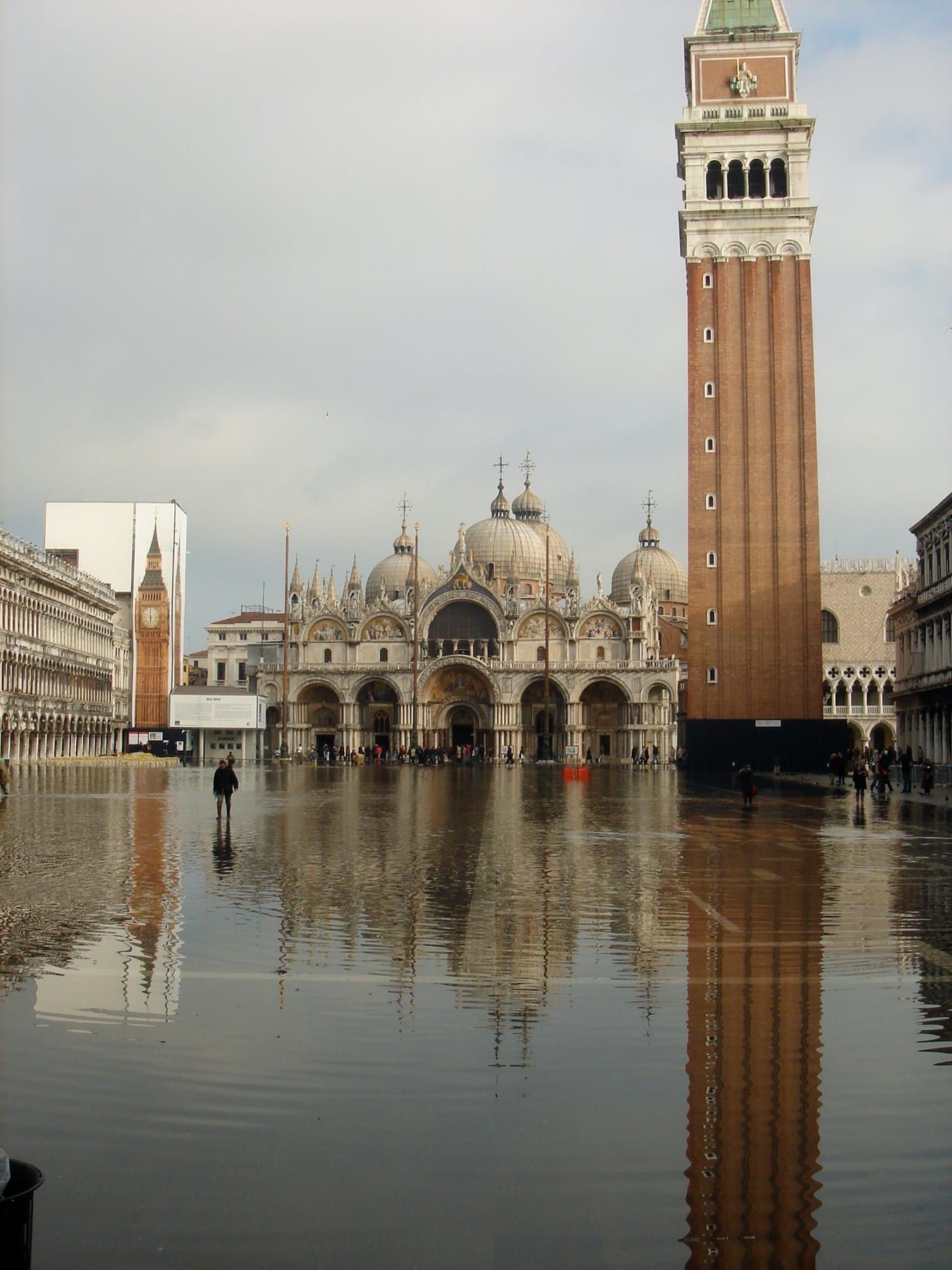
The square is one of the lowest points in Venice and the first place to get wet when the tide rises. According to local reports, water starts appearing in the square at tides of about 80 cm. MOSE, the 78 mobile gates at the lagoon’s three inlets, is normally raised for forecasts of about 110 cm: at lower tides the square can therefore flood even when the gates are not in use. A transparent barrier has been installed around the Basilica to keep water out of the narthex.
How it works in practice:
- When. The highest tides usually fall between October and January, sometimes into spring. The peak lasts a few hours, then the water recedes.
- Sirens. The City warns with sirens: one long tone for a forecast of 110 cm, two rising tones for 120, three for 130, four for 140 cm and above. There is also a free SMS alert service for forecasts of 110 cm or more.
- Walkways. Raised walkways are set up along the main routes, usable up to about 120 cm of tide. Don’t sit on them: that is banned too.
- What to do. Check the forecasts from the City’s Tide Centre, buy a pair of rubber overboots, sold all over town when needed, and move your sightseeing to low-tide hours. At very high tides some vaporetti may skip stops or change route.
When to go
- Early morning. Before 9 the square is almost empty and it is the best time for photos. The Doge’s Palace opens at 9:00, the Basilica at 9:30.
- Evening. Once the tour groups have left, the café orchestras play. In summer the Campanile stays open until 21:15, and from about May to late September the Doge’s Palace closes at 23:00 on Fridays and Saturdays (last entry 22:00): exact dates change every year.
- Sundays. The Basilica opens to visitors only from 14:00. If you want to see it in the morning, choose another day.
- Festivals. 25 April, the feast of St Mark, is the patron saint’s day. During Carnival the square is the main stage and calls for plenty of patience. On 21 November, for the Festa della Salute, Venetians cross the Grand Canal on a votive bridge to the Salute, not far from here.
Tickets for the monuments around the square
The cheapest way to see everything is always through the official channels. The Doge’s Palace (€35, or €30 if bought online at least 30 days ahead) includes Museo Correr, the Archaeological Museum and the Monumental Rooms of the Biblioteca Marciana, and inside it you cross the Bridge of Sighs and the Prisons. Note that tickets without a time slot are admitted to the Doge’s Palace only from 12:00. The Basilica (from €10) and the Campanile (€15) are sold at tickets.basilicasanmarco.it, with a maximum of 5 tickets per account per year. The Clock Tower (€15) is booked at muve.vivaticket.it: if you already hold a Doge’s Palace ticket you pay the €11 reduced rate, and a Clock Tower ticket in turn gives free entry to Correr, the Archaeological Museum and the Marciana.
Online you’ll find the same visits with extra services. They are useful if dates are sold out on the official site, if you have already used your account’s Basilica tickets, or if you want a guide:
-
from €35 per person
Book on Tiqets -
from €19 per person
Book on Tiqets -
from €25 per person
Book on Tiqets
- Doge’s Palace: Fast Track Entry at €35 costs the same as the official ticket and has excellent reviews (4.6 out of 5, almost 9,000 reviews). It is non-refundable and doesn’t get the discount for booking 30 days ahead.
- Basilica hosted entry at €19 against €10 official: the Procuratoria does not allow the bare ticket to be resold, so resellers add a host. The full explanation is on our St Mark’s Basilica page.
- Campanile at €25 against €15 official: the difference pays for a digital audio guide. If you don’t need it, buy on the official site.
If you want everything in one purchase, there are packages. The St Mark’s Square Pass (€67.50) covers the Doge’s Palace, Basilica and Campanile, which cost €60 bought separately through official channels. The Doge’s Palace + Basilica combo costs €76.50, against €45 for the two official tickets.
-
from €67.5 per person
Book on Tiqets -
from €76.5 per person
Book on Tiqets -
from €96.5 per person
Book on Tiqets
A note on a product that confuses many people: the Prison Palace entry at €9.90, entered from the Ponte della Paglia, is a separate guided visit run by a third-party operator. The New Prisons and the Bridge of Sighs are already part of the Doge’s Palace ticket: you don’t need it if you are visiting the Palace.
Gondola rides around the Basin also leave from the waterfront in front of the Piazzetta. On Tiqets, the shared ride that passes under the Bridge of Sighs costs €35 per person for 30 minutes. For fares, routes and advice on private rides, see the dedicated guide at gondolatour.venice.it.
-
from €35 per person
Book on Tiqets
How to get to St Mark’s Square
- By vaporetto from the station or Piazzale Roma. Line 1 runs the whole length of the Grand Canal and reaches San Marco Vallaresso in about 35–40 minutes from Ferrovia, stopping everywhere: it is also the cheapest way to see the Grand Canal. Line 2 is faster and stops at San Marco Giardinetti. From there it is a couple of minutes on foot. A single ticket costs €9.50 and is valid for 75 minutes: see our ACTV vaporetto guide.
- On foot from Rialto. About ten minutes along the Mercerie: the street comes out into the square under the Clock Tower, one of the most theatrical ways to arrive.
- From San Zaccaria. A stop for lines 1 and 2 and for many lines to the islands and the Lido. From here walk along the Riva degli Schiavoni, cross the Ponte della Paglia and you are in the Piazzetta.
Half a day around the square
An order that works, with tickets booked in advance:
- 09:00 — Doge’s Palace, with a time slot (without one you could only enter from 12:00). Allow a good two hours, including the Bridge of Sighs and the Prisons.
- 11:45 — St Mark’s Basilica, with the full ticket: 20 minutes in the church, the Pala d’Oro, then the Museum and the terrace above the square.
- Lunch away from the square, in a bacaro towards Castello or San Polo.
- Afternoon — Clock Tower with a guide, then the Museo Correr, included in your Doge’s Palace ticket.
- Sunset — Campanile, open into the evening in summer, and a coffee with the orchestra if the budget allows.
To plan the rest of your stay, see the other squares, bridges and canals and our ideas for things to do in Venice.
Frequently asked questions
Do you have to pay to enter St Mark's Square?
No, the square is free and always open. On days set by the City, mostly spring and summer weekends, day visitors to Venice must however pay the access fee at cda.ve.it: €5 if bought at least 4 days ahead, €10 after that.
Can you sit down in St Mark's Square?
Not on the ground, on the steps of the Procuratie arcades or on monuments: the city's urban police regulations ban it throughout the historic centre, with fines from €25 to €500. Use the benches or a café table instead.
Can you feed the pigeons in St Mark's Square?
No. Feeding pigeons and gulls is banned throughout the municipality, with fines from €25 to €500. The birdseed sellers who once worked the square are gone.
How much is a coffee at Florian with the orchestra playing?
It depends on what you order, but when the orchestra is playing and you sit at an outdoor table the bill includes a music supplement, recently reported at €7 per person. The amount is shown on a card on the table, so read it before you order.
Which monuments can you visit around St Mark's Square?
St Mark's Basilica (from €10), the Doge's Palace with Museo Correr, the Archaeological Museum and the Marciana rooms (€35), the bell tower (€15), the Clock Tower (€15, guided only) and The Human Safety Net's Casa in the Procuratie Vecchie.
When does St Mark's Square flood?
The square is one of the lowest parts of the city: according to local reports, water starts to appear at tides of about 80 cm. MOSE is normally raised for forecasts of around 110 cm, so at medium tides the square can get wet even with the barriers down. It happens mostly between October and January.
What is the best time to see St Mark's Square?
Early in the morning before the monuments open, or in the evening once the tour groups have gone and the café orchestras are playing. In summer the bell tower stays open until 21:15 and on Fridays and Saturdays the Doge's Palace closes at 23:00.
Official sources
- City of Venice — Urban Police and Safety Regulations
- City of Venice — Tide Forecasting Centre
- City of Venice — Acqua alta warning sirens
- Access fee — Regulation
- St Mark's Basilica tickets — Prices
- St Mark's Basilica — The bell tower
- MUVE — Tickets
- Doge's Palace — Visitor information
- Museo Correr — Visitor information
- Clock Tower — Tickets
- Caffè Florian
- Alajmo — 250 years of Gran Caffè Quadri