Giudecca is the island you see opposite as you walk along the Zattere: a long, narrow strip of houses, churches and old factories, separated from Dorsoduro by the Giudecca Canal, wide enough for the big ships of the past. If you are wondering what to see on Giudecca in Venice, the answer fits in a few lines: Palladio’s Redentore church, the Zitelle, the Molino Stucky and a head-on view of the city that is nowhere else this wide. The island is free, six minutes by vaporetto from San Zaccaria, and still has the life of a neighbourhood: washing on the lines, boatyards, children playing on the waterfront.
It is not a place to “do” in a rushed hour. It is where to come when the centre is packed, to see Venice from the outside and eat in a trattoria full of Venetians.
Why go to Giudecca
The simplest reason is the view. From the Fondamenta delle Zitelle and the Fondamenta di San Giacomo you have the city’s whole southern shore lined up in front of you: the Gesuati church, the Zattere façades, Punta della Dogana and the dome of the Salute. From the eastern tip, near Zitelle, the view swings towards St Mark’s Basin, with the Campanile, the Doge’s Palace and, just across the water, the island of San Giorgio Maggiore. At sunset the light comes from the west and sets exactly these façades glowing: that is the time to come.
The second reason is the pace. Giudecca has few souvenir shops and a lot of homes, side alleys that end in vegetable gardens and inner courtyards, and former factories turned into studios, flats and exhibition spaces. The third is Palladio: two of his Venetian churches stand here, a few hundred metres apart.
The Redentore: the church and the festival
Palladio’s church
The Redentore (Church of the Most Holy Redeemer) is the votive church the Senate of the Republic built after the plague of 1575–77, one of the worst epidemics in the city’s history. The design is by Andrea Palladio: a white Istrian-stone façade that looks like a classical temple, a great dome and two slender bell towers, all meant to be seen from the water. On 13 July 1577 the Senate declared the city free of the disease, and the vow has been renewed every year since.
Inside, the space is bright and restrained, with side chapels and a chancel that opens towards the Capuchin friars’ choir. The monumental sacristy is visited with the Chorus church circuit: the ticket costs €3.50 (official Chorus price, subject to change). Check the church’s opening days and hours on chorusvenezia.org before you go.
The Festa del Redentore
The Festa del Redentore falls every year on the third Sunday of July. The Saturday night before is the “notte famosissima”: thousands of Venetians have dinner in boats or along the banks, and towards midnight the fireworks over St Mark’s Basin begin, reflected in the water between San Giorgio, Giudecca and the Riva degli Schiavoni. For the occasion the Comune lays a votive pontoon bridge across the Giudecca Canal from the Zattere to the church: the only time of year you can walk to the Redentore.
If you want to be there, plan ahead. The best waterfronts (Zattere, Riva degli Schiavoni, the Giudecca fondamenta) fill up from the afternoon, and restaurants overlooking the basin are booked weeks in advance. Vaporetto services are altered that evening, so check ACTV notices. Sunday is the religious day, with a solemn Mass and the procession over the bridge.
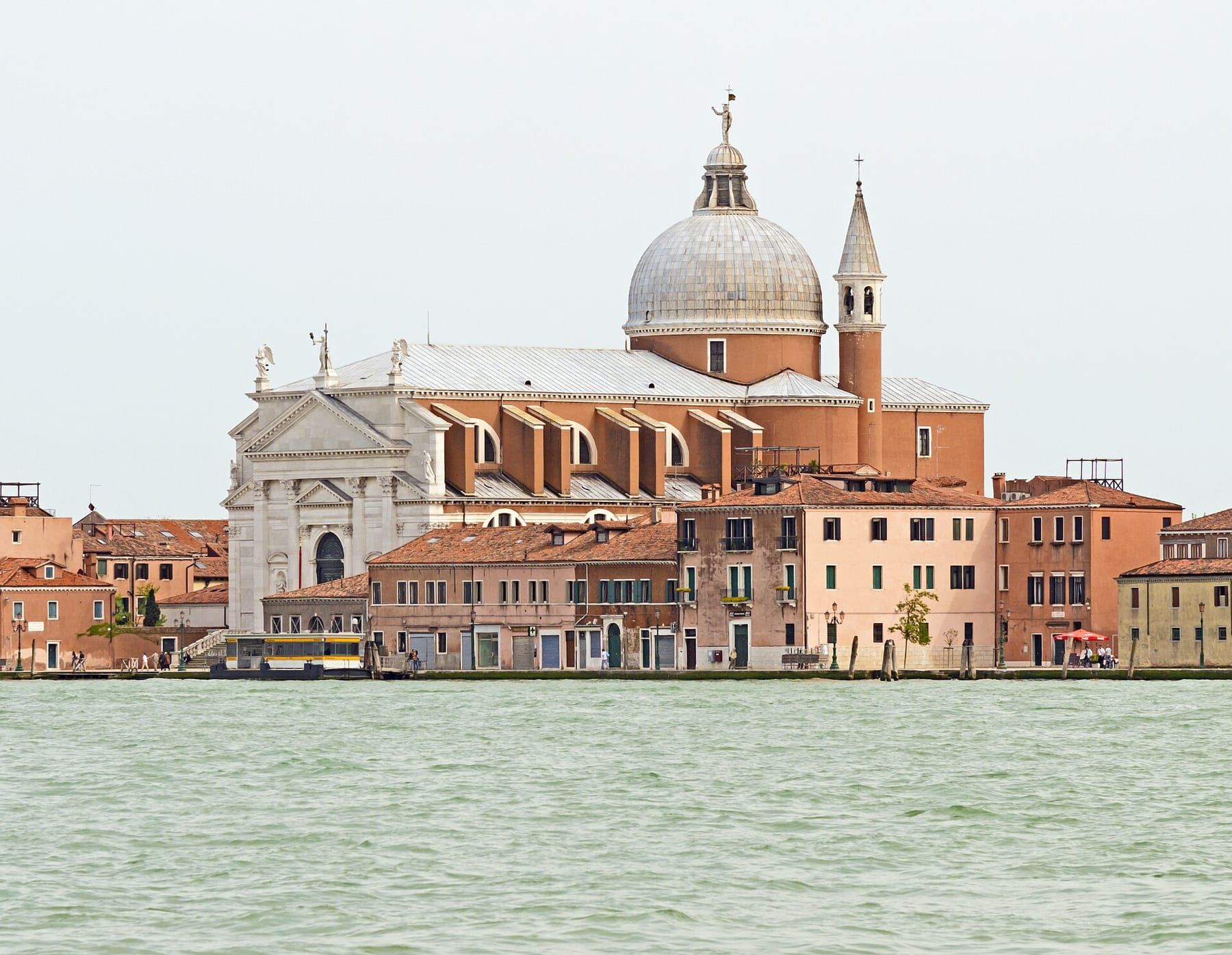
The Zitelle and other churches
The church of Santa Maria della Presentazione, known to everyone as the Zitelle, stands at the island’s eastern tip, next to the stop of the same name. It too was designed by Palladio but built after his death, between 1581 and 1588, by Jacopo Bozzetto. The name comes from the attached institution, which took in poor girls without a dowry and taught them a trade, lace-making in particular. The façade, smaller and more compact than the Redentore’s, with the dome behind, is the first building you see arriving on line 2.
Along the waterfront you pass other parish churches, such as Sant’Eufemia towards Sacca Fisola. Opening hours of the smaller churches are irregular: if they are open, go in; if not, enjoy the façades from outside.
Molino Stucky: from flour mill to hotel with a rooftop
At the western end of Giudecca stands the island’s most recognisable building, a huge red-brick castle in neo-Gothic style with towers and pinnacles. This is the Molino Stucky, built between 1884 and 1895 for the industrialist Giovanni Stucky as a flour mill and pasta factory, in its day one of the largest in Italy. Stucky was murdered in 1910 by one of his workers; the mill kept working until it closed in the mid-1950s and then stood derelict for decades.
Today it is the Hilton Molino Stucky. It is not a monument you can tour, but the hotel’s restaurants and bars are open to non-guests, and the Skyline Rooftop Bar on the top floor is one of the best-known viewpoints in the city: a roof terrace with a 360-degree view over the lagoon, the Zattere and the domes of the centre. Prices are luxury-hotel prices; book ahead, especially for sunset and in summer, because the bar sometimes closes for private events. The nearest stops are Palanca and Sacca Fisola.
Casa dei Tre Oci
On the waterfront between Zitelle and the Redentore, one façade stands out immediately: three large arched windows side by side, the “oci” (eyes, in Venetian) that give the Casa dei Tre Oci its name. It is a neo-Gothic house designed as a home and studio by the painter Mario De Maria in the early 20th century. For years it hosted photography exhibitions; today it belongs to the Berggruen Institute, which has made it its European base and holds exhibitions, talks and symposia there.
Whether you can go in depends on the exhibition programme: when a show is on, the house is open, with hours and tickets published each time. Check the house’s official site before you go.
What a visit to Giudecca costs
The island itself is free. These are the real costs you may meet, at official prices when checked (they can change).
| Item | Price | Channel | Note |
|---|---|---|---|
| Walking the island | free | — | waterfront, alleys, views |
| 75-minute vaporetto ticket | €9.50 | ACTV, official | line 2 from San Zaccaria |
| 24-hour ACTV pass | €25 | ACTV, official | worth it if you add San Giorgio or other islands |
| Redentore sacristy | €3.50 | Chorus, official | check hours on chorusvenezia.org |
| Casa dei Tre Oci | varies | the house’s site | only during exhibitions |
| Skyline Rooftop Bar | drinks | Hilton | booking recommended |
| Tours and experiences | varies | GetYourGuide | walking, boat and food tours |
There is no combined “Giudecca” ticket. Tiqets has no island-specific products; GetYourGuide lists experiences that include it, such as guided walks off the beaten track or boat trips around the basin. Look at them if you want someone to tell you about the neighbourhood; to see the churches and the waterfront, you do not need a guide.
How to get to Giudecca
There is no fixed bridge to the centre: you arrive by boat.
- Line 2 from San Zaccaria: the easiest from St Mark’s. It stops at San Giorgio, then Zitelle (about 6 minutes), Redentore and Palanca, and continues to Zattere, Sacca Fisola, Tronchetto and Piazzale Roma. From the station and Piazzale Roma, take it in the other direction.
- Lines 4.1 and 4.2: the outer circular route, linking Giudecca with Piazzale Roma, San Zaccaria and Fondamente Nove.
- From the Zattere: the shortest crossing, a few minutes to Palanca or Redentore.
- Water taxi: handy with luggage if you are staying at the Hilton or another island hotel; for fares and booking see taxi.venice.it.
The 75-minute ACTV ticket costs €9.50; if you add San Giorgio and perhaps the Lido on the same day, the 24-hour pass at €25 pays for itself from the third ride. All fares are on the ACTV vaporetto page.
The Access Fee applies here too
Unlike Murano, Burano or the Lido, Giudecca is part of the historic city under the Comune’s regulation, as is San Giorgio Maggiore. On days when the Access Fee is in force, day visitors must pay it or register an exemption even if they spend the day only on Giudecca. Anyone staying overnight in accommodation in the Comune, Giudecca included, is exempt but must register. The calendar and rules are on the Access Fee page.
A half-day route
- Zitelle: get off line 2, look at the façade, then turn round towards St Mark’s and San Giorgio.
- Casa dei Tre Oci: a few steps west; go in if there is an exhibition.
- Redentore: Palladio’s church, with the sacristy on the Chorus circuit.
- Waterfront towards Palanca: lunch at a trattoria with tables on the water and a view of the Zattere.
- Inner alleys: detour south to see the island of courtyards, boatyards and gardens.
- Molino Stucky: walk to the end of the island and, if you have booked, go up to the Skyline for sunset.
- Back: line 2 from Palanca or Sacca Fisola towards Zattere or Piazzale Roma, or towards San Zaccaria.
Practical tips
- Comfortable shoes: the northern waterfront is flat and continuous but long; end to end is a fair walk.
- Light: in the morning the city opposite is backlit; afternoon and sunset are best for photos and a drink.
- Staying on Giudecca: hotels are often cheaper than around St Mark’s, a few minutes away by boat. Remember that in the evening you depend on lines 2 and 4.1/4.2.
- Churches: shoulders and knees covered, no visits during services.
- Children: one of the quietest parts of the city, with space for little ones to run without the crowds of the centre.
- July: if you are in Venice on Redentore Saturday, Giudecca is the place to be, but expect crowds and diverted boats.
Combine with
- San Giorgio Maggiore: one stop on line 2, with Palladio’s basilica and the Borges Labyrinth. See Torcello and San Giorgio and San Giorgio, Salute and Frari churches.
- Dorsoduro and the Zattere: cross the canal and carry on to the Salute, Punta della Dogana and the Accademia; see Dorsoduro.
- The other islands: to compare Murano, Burano, the Lido and Torcello, start from the lagoon islands page.
Frequently asked questions
How do I get to Giudecca?
By vaporetto: line 2 runs from San Zaccaria to Zitelle in about 6 minutes, then stops at Redentore and Palanca; lines 4.1 and 4.2 serve the island on the outer loop. There is no fixed bridge to the historic centre, apart from the votive pontoon bridge laid for the Festa del Redentore.
Do I have to pay to visit Giudecca?
No, the island is a lived-in neighbourhood and you can walk around freely. Giudecca is, however, part of the historic city, so on the days when the Comune charges the Access Fee the same rule applies to day visitors as in the centre.
When is the Festa del Redentore?
The festival falls on the third Sunday of July. The famous night is the Saturday before, with fireworks over St Mark's Basin, and a pontoon bridge is laid from the Zattere to the Redentore church for the occasion.
Can you visit the Molino Stucky?
The Molino Stucky is now the Hilton Molino Stucky, so it is not a monument with an entry ticket. Its restaurants and bars are open to non-guests, including the Skyline Rooftop Bar on the top floor, where booking is wise because it sometimes closes for private events.
How much time do I need for Giudecca?
Half a day is enough to walk the waterfront from Zitelle to the Molino Stucky, go into the Redentore and stop for lunch. Add an exhibition at the Casa dei Tre Oci or a sunset drink on the Hilton's roof and plan for a whole afternoon.
What can you see from Giudecca?
From the waterfront you face the whole Zattere shore, with the Gesuati, Punta della Dogana and the dome of the Salute. From Zitelle the view opens onto St Mark's Basin, with the Campanile, the Doge's Palace and the island of San Giorgio.
Who designed the Redentore church?
Andrea Palladio. The Senate commissioned it as a vow for the end of the plague of 1575–77, and the city was declared free of the disease on 13 July 1577. The nearby Zitelle church is also to a Palladian design, built after his death.