The Peggy Guggenheim Collection is one of Italy’s most important museums of twentieth-century European and American art. It fills Palazzo Venier dei Leoni in Dorsoduro, right on the Grand Canal between the Accademia Bridge and the Salute basilica. This is where Peggy Guggenheim, the American collector, lived for thirty years surrounded by Picasso, Pollock, Magritte and her dogs, and it is where she is buried, in the garden.
A visit here feels very different from Venice’s great old-master museums. The galleries are the rooms of a house, bright and human in scale; from the terrace you watch gondolas slide past beneath a bronze horseman; in the garden you wander among sculptures. In an hour and a half, two hours at most, you can see everything calmly. It is also a good stop if you have already had your fill of gold mosaics and Tintoretto and fancy a change of century.
Tickets and prices: €17 official, €20 on Tiqets
The ticket covers Peggy Guggenheim’s permanent collection, the Hannelore B. and Rudolph B. Schulhof Collection, the Nasher Sculpture Garden and, as a rule, the temporary exhibitions on at the time. All prices can change, so check the official website before you pay.
| Ticket | Official website | On Tiqets |
|---|---|---|
| Full | €17 | €20 |
| Over 70 | €14 | — |
| Students under 26 (with card) | €9 | — |
| Children under 10 and members | free | — |
| Audio guide | €7 | not included |
Let’s be clear: the official ticket is cheaper. On Tiqets the full “fast track” ticket costs €20, €3 more per person than the €17 on the museum’s own website, and it is non-refundable. Buying on the official site also lets you skip the ticket-office queue, because you walk in with your online ticket. Tiqets makes sense mainly if you already use its app for other Venice tickets and like having everything in one place, with instant confirmation on your phone. If you are travelling with young people, students or over-70s, buy on the official site: the Tiqets listing only offers the full-price ticket.
Price list compared
Live prices from our partner feeds, cheapest first. Tap a button to open the listing.
| Platform | Price | Rating | Duration | Book |
|---|---|---|---|---|
| Tiqets Peggy Guggenheim Collection: Fast Track Ticket Best price | €20per person | ★ 4.6755 reviews | — | Book on Tiqets |
-
from €20 per person
Book on Tiqets
Do you need to book?
It is not compulsory: the museum’s desk also sells tickets on the spot. The museum does recommend buying online, though, and it is right. On spring weekends, in summer and during the months of the Biennale, the queue at the ticket office in the middle of the day can be long. With your ticket already in hand, arriving at 10:00 sharp or after 16:00 is the easiest way to find quiet galleries.
Dorsoduro Museum Mile
The Peggy Guggenheim is part of the Dorsoduro Museum Mile, together with the Gallerie dell’Accademia, Palazzo Grassi–Punta della Dogana and Palazzo Cini. According to the scheme, a paid ticket at one of the museums gets you the reduced rate at the others within 7 days: €14 at the Guggenheim, €17 at the Accademia. Keep your ticket and show it at the desk; the exact conditions are on the museums’ websites.
Opening hours: watch out for Tuesdays
The Collection is open every day except Tuesday, from 10:00 to 18:00, with last entry at 17:00. It is also closed on 25 December. The Tuesday closure is the thing to remember when you plan Dorsoduro: the Gallerie dell’Accademia, five minutes’ walk away, closes on Mondays instead. From Wednesday to Sunday you can see both on the same day; on Mondays only the Guggenheim is open, on Tuesdays only the Accademia.
When to go
From May to November Venice hosts the Biennale, devoted to art in even-numbered years and to architecture in odd-numbered ones. During those months the contemporary-art crowd fills the Guggenheim, and the museum’s temporary shows are often designed to talk to the Biennale: it is the most interesting period, but also the busiest. A useful detail: the Biennale pavilions at the Giardini and the Arsenale usually close on Mondays, while the Guggenheim is open on Mondays. If you have one Monday in Venice during the Biennale, this is the museum for it.
In winter, especially on weekdays in January and February outside Carnival, the galleries are quiet even at midday and the low light on the terrace is beautiful. Bear in mind, though, that during acqua alta the fondamenta of Dorsoduro towards the Salute can flood for a few hours: check the tide forecast before you set out.
Who was Peggy Guggenheim?
Peggy Guggenheim (1898–1979) was the daughter of Benjamin Guggenheim, who died in the sinking of the Titanic, and the niece of Solomon R. Guggenheim, founder of the New York museum. In the 1930s and 1940s, between London, Paris and New York, she bought work by then little-regarded artists at a remarkable pace: the story goes that her aim was to “buy a picture a day”. In New York she opened the Art of This Century gallery, where she introduced, among others, the young Jackson Pollock, and for a few years she was married to the painter Max Ernst.
In 1948 her collection was shown at the Venice Biennale, in the Greek pavilion, and was a great success. The following year Peggy bought Palazzo Venier dei Leoni and moved in. From 1951 she opened her home and collection to the public during the warmer months. On her death in 1979 the collection passed to the Solomon R. Guggenheim Foundation, which still runs it alongside the museums in New York and Bilbao, and has kept it open all year round since 1980.
The “unfinished” palace
Palazzo Venier dei Leoni is an unfinished palace: it was begun in 1748 to a design by the architect Lorenzo Boschetti for the Venier family, but building stopped at ground-floor level. That is why, seen from the Grand Canal, it looks like a long, low building of white stone squeezed between much taller palaces. Tradition says the name “dei Leoni” comes from the lions’ heads carved along the water façade.
How the visit works
You enter from the street side, not from the Grand Canal. The unfinished palace spreads out rather than up, so the visit is easy even with a pushchair.
An order that works:
- The rooms of the house, where Peggy lived, with the permanent collection laid out roughly in chronological order: from Cubism and the early-century avant-garde to Surrealism and the post-war Americans.
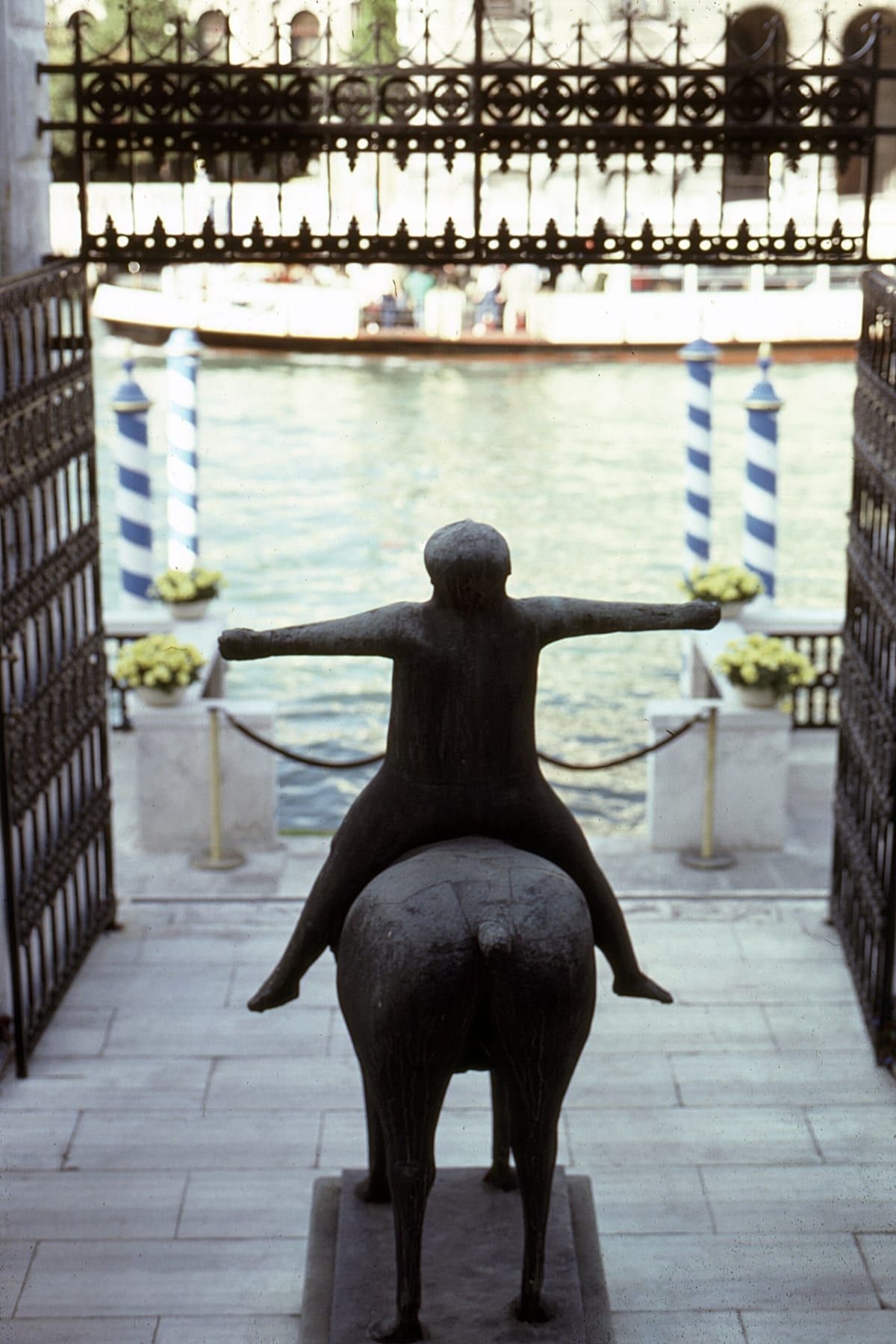
- The Grand Canal terrace, in the middle of the façade, with the Angel of the City. It is worth coming back at the end, once the light has changed.
- The Schulhof Collection and the temporary exhibition rooms, in the spaces added around the garden.
- The sculpture garden, with Peggy’s grave and, if you need a break, the café.
If you want a thread to follow, the €7 audio guide covers both the works and Peggy’s life in the house: worth the money if twentieth-century art is new to you.
What to see: the works not to miss
The collection covers the great movements of the first half of the twentieth century: Cubism, abstract art, Surrealism and American Abstract Expressionism. Works can rotate or go on loan to other exhibitions, so don’t assume every single painting will be on the wall: if there is one you care about, check the “on view” note on its page on the museum’s website.
René Magritte, Empire of Light
The museum’s signature painting: a night-time street with a lit lamp post, under a blue daytime sky full of clouds. Magritte painted it in 1953–54, and the effect of day and night in the same image is more unsettling than photographs suggest. Give it a few minutes.
Jackson Pollock
Peggy was Pollock’s first great champion, and the collection holds some key works, such as Alchemy, one of his first paintings made with the “drip” technique, and The Moon Woman, from a few years earlier. Look at them close up and then from a distance: they become two different pictures.
Marino Marini, The Angel of the City
On the terrace facing the Grand Canal stands the museum’s most photographed sculpture: a naked bronze rider, arms flung wide, on a horse with its neck strained forward. This is The Angel of the City by Marino Marini, made in 1948 and cast in 1949. People passing on the vaporetto see it from the water; from the terrace you get the reverse view, across the Grand Canal to the palaces on the far bank and the Accademia Bridge.
The other names
In the galleries you will meet Picasso, Kandinsky, Mondrian, Brancusi, Giacometti, Max Ernst, Dalí, de Chirico, Miró and Alexander Calder. The Schulhof Collection, donated to the museum, adds European and American art from the second half of the century. Alongside the permanent collection the museum stages temporary exhibitions, often in the rooms facing the garden.
The garden and Peggy’s grave
The Nasher Sculpture Garden is a small green oasis: sculptures among the trees, shady benches, a café. In one corner is Peggy Guggenheim’s grave: her ashes lie here, next to the stone where her dogs are buried, the Lhasa Apsos who kept her company all her life, each with its name carved into the stone. It is one of the most unexpected and personal places in all of Venice.
Audio guide, tours and services
- Audio guide: €7, in several languages. The museum also runs guided tours; check the website for the schedule and languages.
- Bags: backpacks and large bags are not allowed in the galleries. There are free lockers at the entrance. Don’t turn up with suitcases.
- Photos: allowed without flash or tripod.
- Accessibility: the spaces are accessible, pushchairs are allowed and service animals are welcome.
- Time: allow an hour and a half for the collection and the garden, two hours if there is a temporary exhibition you want to see.
- Children: under-10s go free, and the terrace, the garden and Calder’s shapes work well even with little ones.
Getting there
The museum is at Dorsoduro 701, between the Accademia Bridge and the Salute. The entrance is on the street side, not on the Grand Canal: follow the signs for the “Collezione Peggy Guggenheim” on the walls along the way.
- By vaporetto: Accademia stop, served by lines 1 and 2, then about five minutes on foot heading east. Or the Salute stop on line 1, a few minutes from the entrance. A single ticket costs €9.50 and is valid for 75 minutes; details are on our ACTV vaporetto page.
- On foot from St Mark’s: cross the Accademia Bridge from Campo Santo Stefano and follow the signs for the Salute, about 15–20 minutes in all. Or take the traghetto Santa Maria del Giglio–Salute (€2), a gondola that crosses the Grand Canal in a few minutes.
- From Rialto: line 1 takes you to Accademia past the palaces of the Grand Canal: a sightseeing trip in itself.
What to see nearby
The Peggy Guggenheim sits at the heart of Venice’s most museum-packed district, covered on our Dorsoduro page:
- Gallerie dell’Accademia, five minutes away: the great Venetian painting from the fourteenth to the eighteenth century, from Bellini to Titian. Closed on Mondays. Everything is on our Gallerie dell’Accademia page.
- Salute basilica and Punta della Dogana, a few minutes east: the votive Baroque church and the Pinault Collection’s contemporary art museum on the tip between the Grand Canal and the Giudecca Canal. See our page on the Salute, San Giorgio and the Frari.
- The Zattere, the long sunny waterfront on the Giudecca Canal, perfect for an ice cream after the museum.
- Ca’ Rezzonico, the museum of eighteenth-century Venice, one vaporetto stop away: you will find it on our Ca’ Pesaro and Ca’ Rezzonico page.
A day in Dorsoduro, with the sums done
An itinerary that works from Wednesday to Sunday: the Accademia at 9:00 when it opens, for two hours of Venetian painting; lunch in Campo San Barnaba or on the Zattere; the Guggenheim in the early afternoon; sunset on the Salute waterfront. At official prices you pay €20 for the Accademia and, with the Dorsoduro Museum Mile reduction, €14 instead of €17 for the Guggenheim: €34 each instead of €37. If you are an EU citizen aged 18–25 the Accademia costs just €2, and as a student under 26 you pay €9 at the Guggenheim.
Frequently asked questions
How much is a ticket to the Peggy Guggenheim Collection?
On the official website a full ticket costs €17, over-70s pay €14 and students under 26 pay €9 with ID. Children under 10 go free. On Tiqets the ticket costs €20, which is €3 more.
Which day is the Peggy Guggenheim museum closed?
The museum is closed on Tuesdays and on 25 December. On other days it opens 10:00–18:00, with last entry at 17:00.
Do I need to book the Peggy Guggenheim in advance?
It is not compulsory: tickets are also sold at the desk. The museum does recommend buying online, because on busy days, in spring, in summer and during the Biennale, the queue at the ticket office can be long.
What are the most famous works in the collection?
Highlights include Magritte's Empire of Light, paintings by Jackson Pollock, Marino Marini's Angel of the City on the Grand Canal terrace and works by Picasso, Kandinsky, Dalí, de Chirico, Max Ernst and Calder. Some works may be on loan to temporary exhibitions.
Where is Peggy Guggenheim buried?
Peggy Guggenheim died in 1979 and her ashes lie in the palazzo's garden, next to the stone marking her beloved dogs' graves. The grave is in a corner of the sculpture garden and can be seen with the normal ticket.
Can I bring a backpack?
No, backpacks and large bags are not allowed in the galleries. There are free lockers at the entrance. Photos are allowed without flash or tripod.
How far is the Peggy Guggenheim from the Accademia Gallery?
About five minutes on foot through Dorsoduro. Remember that the Accademia closes on Mondays and the Guggenheim on Tuesdays, so from Wednesday to Sunday you can see both on the same day.