Murano is a small archipelago of islets linked by bridges, about a kilometre and a half north of Fondamente Nove, and for centuries its name has meant glass: according to tradition, the Republic concentrated the furnaces here in 1291, partly to keep the risk of fire away from the city. Today Murano island is one of the easiest trips from Venice, 9 minutes by vaporetto, combining working furnaces, the museum with the largest historical collection of Murano glass, a Romanesque basilica with a 12th-century mosaic floor and canals far calmer than those in the centre.
In this guide you will find the vaporetto lines and stops, things to see and do in Murano, how to choose a glass demonstration, how to recognise genuine glass, how long to stay and how to combine Murano with Burano and Torcello.
Getting to Murano: lines and stops
Murano has seven ACTV stops: Colonna, Faro, Navagero, Museo, Venier, Da Mula and Serenella. Which one to use depends on where you start and what you want to see first.
| Line | From | Murano stops | Approximate time | When to use it |
|---|---|---|---|---|
| 12 | Fondamente Nove | Faro | 9 minutes | The fastest; continues to Mazzorbo and Burano |
| 13 | Fondamente Nove | Faro | about 9 minutes | Continues to Vignole and Sant’Erasmo |
| 3 | Piazzale Roma, Ferrovia | Colonna, Faro, Navagero | about 17 minutes to Colonna | Direct from the station, without crossing the centre |
| 4.1 / 4.2 | Fondamente Nove, Ferrovia, Piazzale Roma (circular) | Colonna, Serenella, Venier, Da Mula, Museo | varies with direction | Stops at Museo, in front of the Glass Museum; calls at San Michele cemetery |
| 7 | San Zaccaria | Navagero, Faro, Colonna | about 24 minutes, roughly every 30 minutes | From St Mark’s without changing, daytime only |
| Alilaguna Blue and Red | Marco Polo airport | Colonna | — | €10 from the airport to Murano; Red runs in summer only |
The 75-minute ACTV ticket costs €9.50; if you are also going to Burano or Torcello the same day, the €25 24-hour pass pays for itself straight away. Fares and advice are in the ACTV vaporetto guide. By water taxi, the official fare between the historic centre and Murano is €60 for the boat, and the same from the airport.
The practical tip: from the station take line 3 and get off at Colonna, at the start of the Fondamenta dei Vetrai; to move on to Burano, head for Murano Faro, where line 12 stops.
Things to see in Murano
Glass furnaces and demonstrations
Watching a master glassmaker at work is why almost everyone comes to Murano: in a few minutes a glowing blob of glass becomes a little horse, a vase or a drinking glass, worked with the blowpipe, the tongs and a furnace at over a thousand degrees. Demonstrations usually last 10 to 20 minutes, some up to half an hour.
There are three kinds:
- “Free” demonstration in a furnace along the quays, often offered by someone who stops you as you step off the vaporetto. Entry costs nothing, but the route ends in the showroom and the pressure to buy can be strong.
- Ticketed demonstration, such as the one at the Glass Cathedral in the former church of Santa Chiara (Fondamenta Daniele Manin 1, not far from the Colonna stop): about 30 minutes in a sacred building turned into a furnace. On Tiqets it costs €14, averages 4.7 out of 5 and can be cancelled free until the day before.
- Guided demonstration: on Tiqets, for €10, there is a guided visit to a furnace with a demonstration (4.5 out of 5, over 100 reviews, free cancellation until the day before).
Price list compared
Live prices from our partner feeds, cheapest first. Tap a button to open the listing.
| Platform | Price | Rating | Duration | Book |
|---|---|---|---|---|
| Tiqets Murano: Glass Blowing Demo + Tour Best price | €10per person | ★ 4.5101 reviews | — | Book on Tiqets |
| Tiqets Murano: Glass Blowing Demo at the Glass Cathedral | €14per person | ★ 4.747 reviews | 30 min | Book on Tiqets |
As a rule the furnaces work mainly on weekdays; on Sundays some are idle or only have displays, so if the demonstration is the reason for your trip, book it. The islands boat tours almost always include a demonstration in a partner furnace.
The Glass Museum
In Palazzo Giustinian, the former residence of the bishops of Torcello, the Civic Museums’ Glass Museum holds what MUVE calls the world’s largest historical collection of Murano glass, arranged chronologically: from Roman pieces of the 1st–3rd centuries AD to contemporary work, by way of great Renaissance goblets, chandeliers and filigree glass. It began as an archive in 1861, founded by mayor Antonio Colleoni and abbot Vincenzo Zanetti.
- Where: Fondamenta Giustinian 8, Museo stop (lines 4.1, 4.2 and 3).
- Hours: daily, 1 April–31 October 10:00–18:00 (last entry 17:00), 1 November–31 March 10:00–17:00 (last entry 16:00). From May to September it usually stays open until 20:00 on Fridays and Saturdays.
- Official prices: €15 full, €7.50 reduced (ages 6–14, students 15–25, over-65s, Rolling Venice), free under 6. Audio guide included. The museum is accessible, with a lift.
- On Tiqets entry costs the same €15, non-refundable: handy if you are booking other things on the same platform, but age-based reduced tickets can only be bought online on the official site.
If you are also going to Burano and Torcello, the Island Museums ticket at €20 (reduced €10, valid three months) covers the Glass, Lace and Torcello museums. The Civic Museums’ Museum Pass (€50) includes the Doge’s Palace too.
-
from €15 per person
Book on Tiqets -
from €14 per person
Book on Tiqets -
from €10 per person
Book on Tiqets
The basilica of Santi Maria e Donato
A few steps from the museum, facing the canal with an apse wrapped in two tiers of arcades, the basilica of Santi Maria e Donato is one of the great Veneto-Byzantine monuments of the lagoon, rebuilt in the 12th century. Look down: the mosaic floor of marble and coloured tesserae, with animal figures and geometric patterns, carries an inscription dated 1141. In the apse, on a gold ground, a large mosaic Madonna dominates, recently restored with support from Save Venice. Behind the altar hang large bones that legend says belonged to the dragon slain by St Donatus, whose relics are kept in the church.
According to the parish, entry is free and the basilica is open during the day, on Sundays after Mass; hours can change, so check on the spot or at sandonatomurano.it. It is a working church: cover shoulders and knees.
The Murano lighthouse
Next to the Murano Faro stop, looking across the lagoon towards Venice, stands the Murano lighthouse (faro), an Istrian-stone tower built in 1934 to replace a metal tower of 1912; there had been navigation lights on the spot for centuries. It cannot be visited, but it is the first building you see arriving from Fondamente Nove on line 12, and a fine spot for photographing the lagoon towards Venice and San Michele, especially at sunset.
Fondamenta dei Vetrai and San Pietro Martire
From the Colonna stop, the Fondamenta dei Vetrai runs along the canal of the same name and is the island’s main street: showrooms, small furnaces, glass-bead shops and bars with tables by the water. Halfway along, the church of San Pietro Martire holds two altarpieces by Giovanni Bellini. Carry on across the bridge over Murano’s own Grand Canal, wider and quieter, to reach the museum and San Donato.
Buying genuine Murano glass
Shops in Venice, and on Murano itself, sell plenty of “Murano-style” objects made elsewhere. To get it right:
- Look for the Vetro Artistico® Murano mark. It was created by Veneto regional law no. 70 of 1994 and is owned by the Region, which publishes the list of firms authorised to use it. The mark comes with the piece as a label or certificate.
- Buy from the maker. Many furnaces have their showroom next to the workshop: seeing the piece made and talking to the glassmaker is the best guarantee.
- Be wary of prices that are too low. A hand-blown glass, a chandelier or a murrine vase takes hours of work; pendants and little animals for a few euros are often imported.
- Always ask for an invoice or a receipt with a description, and for large pieces ask for insured shipping rather than packing them in your suitcase.
Techniques to recognise
Knowing what you are looking at helps you understand the price and ask the right questions in the shop.
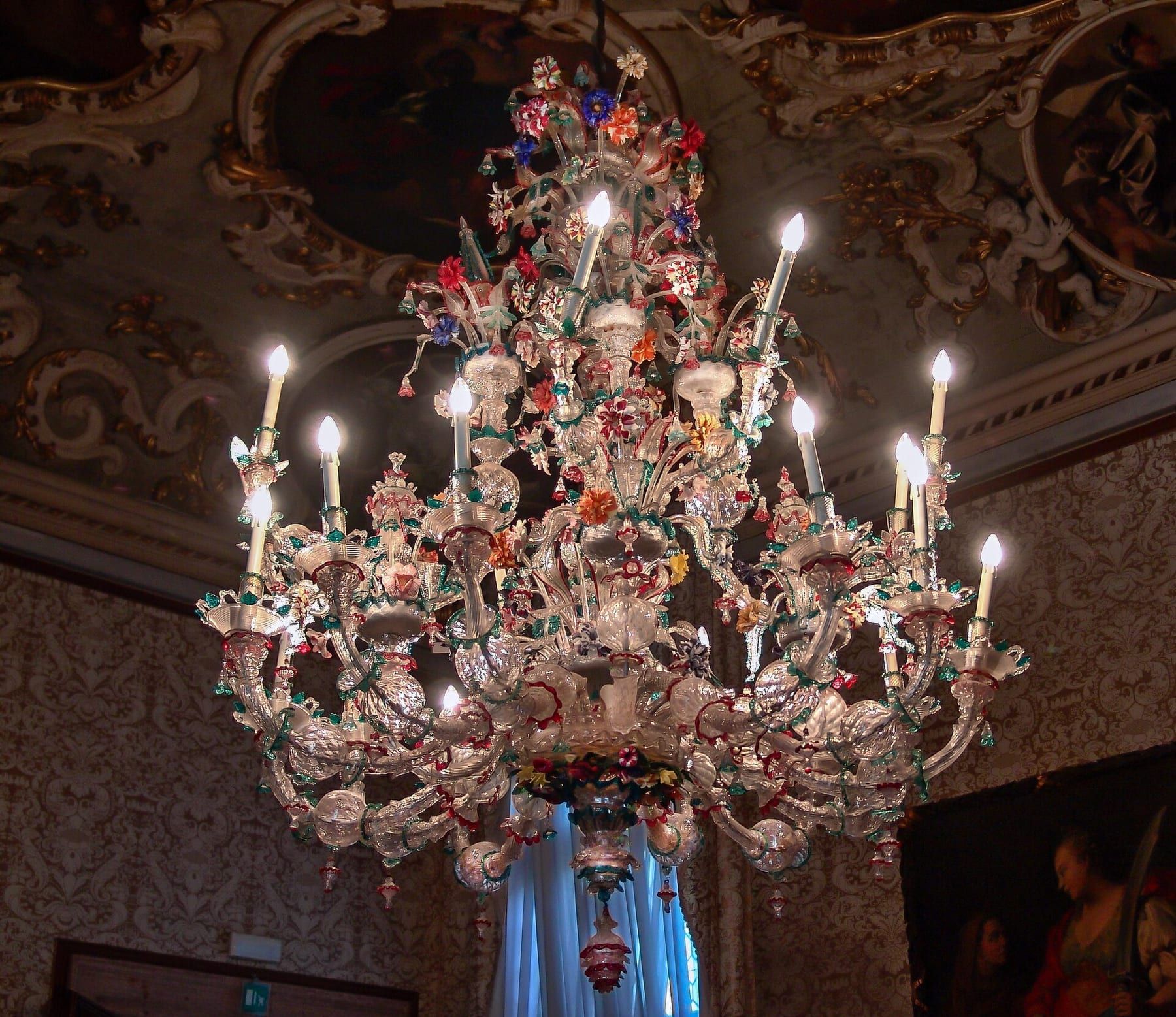
- Blown glass: glasses, goblets, vases and chandeliers start as a bubble blown through the pipe and shaped while hot. A handmade set of goblets shows small differences between pieces: that is a mark of quality, not a flaw.
- Murrine: thin slices of multicoloured glass canes, placed side by side and fused to form flowers and patterns. They are the typical motif of pendants, plates and paperweights.
- Filigree and reticello: white or coloured glass threads embedded in clear glass, in spirals or a net. They take great skill and you can tell them by the regularity of the pattern.
- Lampwork (lume): glass worked in the flame of a torch, used for glass beads and small figures. “Venetian beads” have a long tradition and are made in many workshops on the island.
- Sommerso: layers of different colours cased inside the same piece, typical of 20th-century vases and sculptures.
The Glass Museum has historical examples of all these techniques: seeing them before you shop is the best way to train your eye.
The Promovetro consortium, founded in 1985, brings together more than forty Murano firms and does not sell visits: it is a useful reference for knowing who actually produces on the island.
How long to stay and a half-day itinerary
Two hours is enough for a demonstration and a walk between the Fondamenta dei Vetrai and the lighthouse. Three or four hours lets you do everything calmly: a furnace, the Glass Museum (about an hour and a half), San Donato and lunch or a spritz by the water.
A route that works:
- Line 3 from Ferrovia to Murano Colonna (about 17 minutes), or line 12 from Fondamente Nove to Faro.
- Demonstration at the Glass Cathedral or in a furnace near Colonna.
- Fondamenta dei Vetrai and San Pietro Martire, then the bridge over Murano’s Grand Canal.
- Glass Museum (Museo stop) and, close by, Santi Maria e Donato.
- The lighthouse at sunset, then from Murano Faro line 12 to Burano, or line 12 or 13 back to Fondamente Nove in 9 minutes.
With a whole day, Murano pairs well with Burano (32 minutes on line 12) and Torcello: the full itinerary is on the Venice islands page. A stop at San Michele cemetery, Cimitero stop on lines 4.1 and 4.2, fits in nicely on the way there or back.
When to go
The Glass Museum is open every day, Mondays included, whereas the Lace Museum on Burano and the museum on Torcello close on Mondays: if you have a free Monday, it is the ideal day for Murano. The furnaces work mainly on weekdays and in the daytime, so the morning is the best time to see a glassmaker in action. In summer, between May and September, the museum usually stays open until 20:00 on Fridays and Saturdays, and an evening on Murano, with the lighthouse at sunset and the boat back as the light fades over the lagoon, is worth the trip in itself.
Murano on the way to or from the airport
Alilaguna’s Blue and Red lines stop at Murano Colonna: from Marco Polo airport the ticket to Murano costs €10, against €18 to central Venice, and includes one suitcase up to 160 cm in total dimensions plus one piece of hand luggage. If you are staying on Murano or want to spend a few hours there on arrival, it is the most direct connection. ACTV tickets are not valid on Alilaguna, and vice versa.
Organised tour or DIY?
Murano is the easiest island to reach on your own, and for a visit here alone you do not need a tour: a €9.50 ticket or the day pass will do. Boat tours make sense if you want to see Murano, Burano and Torcello without thinking about connections: on Tiqets the Murano and Burano with demonstration tour costs €25 (3.9 out of 5, over 1,200 reviews) and the one that adds Torcello €20 (4 out of 5, over 1,300 reviews), both non-refundable and with fixed timings on each island. No tour includes the Glass Museum.
-
from €25 per person
Book on Tiqets -
from €20 per person
Book on Tiqets
Practical tips
- Access fee: not charged on Murano.
- Crowds: tour groups arrive between 11:00 and 15:00; early morning and late afternoon the island is much quieter.
- Eating: there are seafood trattorias along the quays; prices are often lower than around St Mark’s, but always check the menu on display.
- Accessibility: the quays are flat but the bridges have steps; the Glass Museum has a lift.
- With children: the glass demonstration is usually what they remember most; the museum’s reduced ticket applies from 6 to 14.
- Winter: the museum closes at 17:00 and it gets dark early, so set off in the morning.
Frequently asked questions
How do I get to Murano from Venice?
The quickest way is line 12 or 13 from Fondamente Nove: 9 minutes to Murano Faro. From the station and Piazzale Roma there is the direct line 3, about 17 minutes to Colonna, and from San Zaccaria line 7, about 24 minutes.
Are the glass demonstrations on Murano free?
Some furnaces let you in free for a short demonstration that ends in the showroom. Ticketed demonstrations, such as the one at the Glass Cathedral in the former church of Santa Chiara (about 30 minutes, €14 on Tiqets), are calmer and come with no obligation to buy.
How long should I spend on Murano?
Two hours is enough for a demonstration and a stroll along the Fondamenta dei Vetrai. With the Glass Museum and the basilica of Santi Maria e Donato, allow three or four hours, in other words half a day.
How can I tell genuine Murano glass?
Look for the Vetro Artistico® Murano mark, created by a Veneto regional law and reserved for authorised firms, whose list the Region publishes. Always ask for an invoice or certificate, and be wary of prices too low for a handmade piece.
Can you visit the Murano lighthouse?
No, the lighthouse is not open to the public. The current Istrian-stone tower dates from 1934 and is easy to see from the Murano Faro stop, served by lines 3, 7, 12 and 13.
How much is the Murano Glass Museum?
The official ticket costs €15, reduced €7.50, and includes the audio guide. For €20 the Island Museums ticket adds the Burano Lace Museum and the Torcello Museum.
Do I pay the access fee on Murano?
No, Murano is excluded from the access fee like the other lagoon islands. But if you pass through the historic centre to catch your boat on a charged day, the centre's rule applies to that part of the day.
How do I get from Murano to Burano?
Take line 12 from Murano Faro: about 32 minutes to Burano, with a stop at Mazzorbo. In the daytime it runs roughly every 20 minutes.