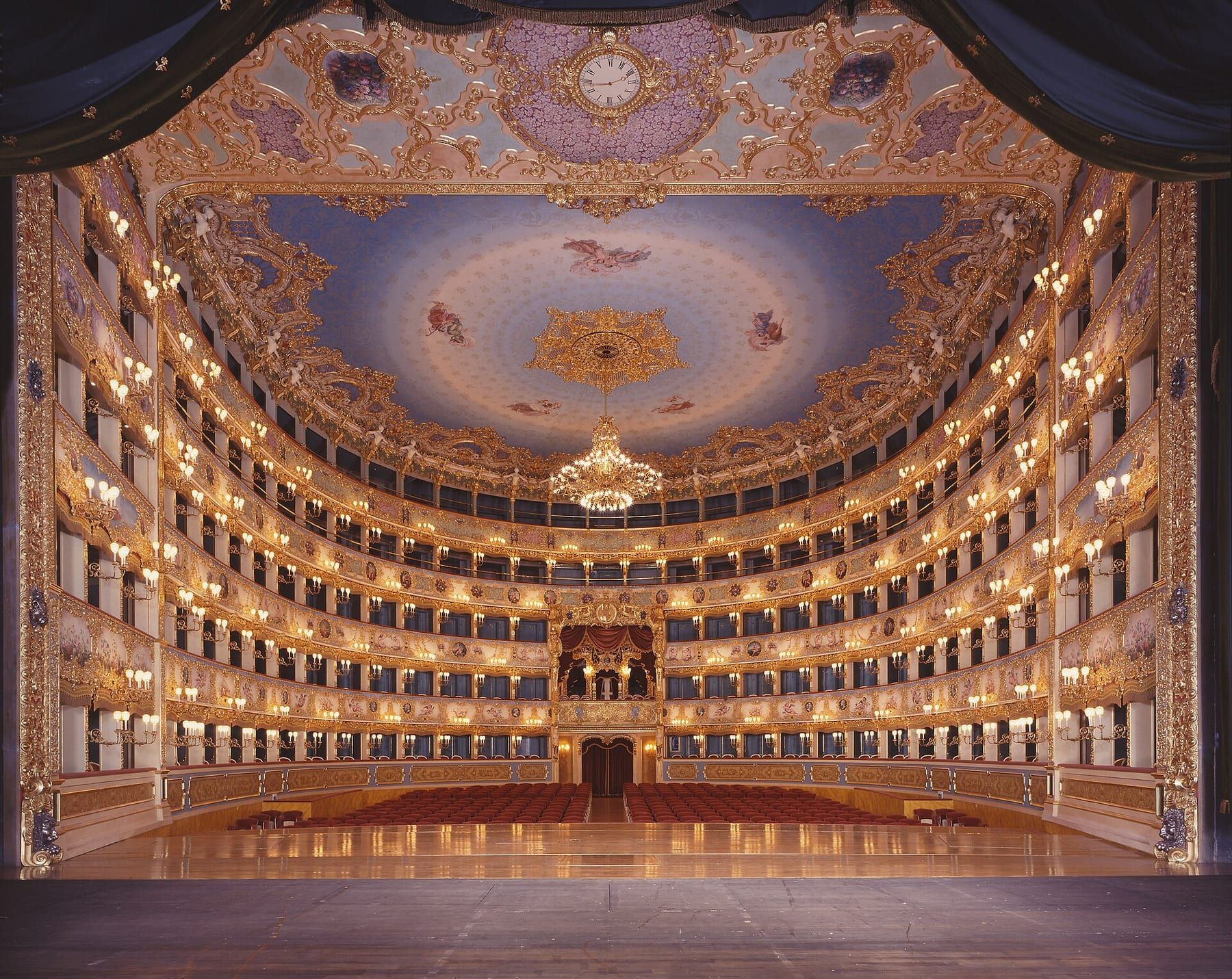
Teatro La Fenice is Venice’s opera house and one of the most famous in the world. It stands on Campo San Fantin, five minutes from St Mark’s Square, and you can experience it in two ways: by day on a visit, audio guide included, or by night at a performance. The visit costs €14 on Venezia Unica and on Tiqets; the visits operator’s own page still shows €12. For opera, the price depends on the production and the section.
Here you’ll find prices and sales channels for both, the house rules, the dress code and the story of a theatre that has burned twice and been rebuilt each time.
La Fenice visit: tickets and prices
Visits are run by Fest Fenice, the theatre’s services company. The visit is self-guided with a free audio guide in 10 languages (Italian, English, German, French, Spanish, Portuguese, Russian, Chinese, Japanese and LIS, Italian Sign Language): you leave an ID document to collect the device, or download the app to your phone.
The official sources don’t agree on the price. Venezia Unica, the city’s official sales network, sells the full ticket at €14, and Tiqets charges the same. Fest Fenice’s page, however, still lists €12 full, €9 for over-65s and €7 for students aged 7 to 26. Treat €14 as the current reference price and, if you buy at the desk, check on the spot.
| Option | Price | Channel | What’s included |
|---|---|---|---|
| Audio-guided visit, full | €14 | Venezia Unica (official) | Entry, audio guide, Maria Callas exhibition |
| Audio-guided visit, full | €12 | Fest Fenice page (official, possibly out of date) | As above |
| Reduced | €10 over-65 members of partner organisations · €8 students 7–26 (Venezia Unica); €9 / €7 on Fest Fenice | Official | As above |
| Under 6 | free | Official | As above |
| Family ticket | €25 with one child (7–18), up to €40 with four | Fest Fenice | As above |
| Guided group visit | €14 per person, €160 minimum, about 45 minutes | Fest Fenice, booking required | Guide in Italian, English or French |
| Skip-the-line audio guide | €14 | Tiqets | Entry and an audio guide to download to your phone |
| 1-hour guided tour | €25 | Tiqets | Entry and an expert guide |
All prices can change. The Venezia Unica site also lists a combined visit to La Fenice and the Music Museum at San Maurizio: if you want both, compare it with the price of two separate tickets.
Price list compared
Live prices from our partner feeds, cheapest first. Tap a button to open the listing.
| Platform | Price | Rating | Duration | Book |
|---|---|---|---|---|
| Tiqets La Fenice Opera House: Skip The Line + Audio Guide Best price | €14per person | ★ 4.61,249 reviews | — | Book on Tiqets |
Tiqets or the official ticket?
For the audio-guided visit the price is the same: €14 on Tiqets and on Venezia Unica. The Tiqets product, rated 4.6 from more than 1,200 reviews, comes with one condition worth knowing: it cannot be cancelled. That’s fine if your date is certain; if your plans might change, buying at the desk carries no risk.
The Tiqets guided tour (€25, one hour, rated 4.0) makes more sense: official guided tours are reserved for groups, with a €160 minimum, so for solo travellers and couples it’s the only way to have a real guide. It can be cancelled up to the chosen date.
-
from €14 per person
Book on Tiqets -
from €25 per person
Book on Tiqets
Opening hours and booking
The theatre is normally open for visits every day from 9:30 to 18:00. La Fenice’s website warns that hours may change for artistic or technical reasons: on dress-rehearsal or set-building days the visit can be shortened or suspended, sometimes at short notice. The up-to-date calendar is on festfenice.com; Fest Fenice answers queries on +39 041 786672.
The booking information conflicts too. Fest Fenice writes that for individual visitors booking is “neither necessary nor possible”, while other official information says it is required at weekends and on public holidays. In practice: on weekdays you can just turn up at the desk; at weekends and on long holiday weekends, buying ahead removes the doubt. Groups must always book.
The visit takes on average 45–60 minutes. The best time is early morning, before the groups arrive.
What you see inside
The route follows the sequence the audience experiences in the evening:
- The foyer and grand staircase, rebuilt after the 1996 fire with marble and stucco faithful to the original.
- The auditorium, horseshoe-shaped, with tiers of gilded boxes, the gallery above and the painted ceiling with its great chandelier.
- The Royal Box, at the centre of the hall, the best place to take in the curve of the tiers. From here you see the theatre as guests of honour do.
- The Apollonian Rooms (Sale Apollinee), the neoclassical rooms used for receptions, talks and small concerts.
- The permanent Maria Callas exhibition, devoted to the soprano’s Venetian years; she sang key roles of her career at La Fenice.
If a production is being set up, you may see scenery on the stage: no two visits are quite the same.
Tickets for opera, ballet and concerts
La Fenice’s season mixes opera, ballet and symphonic concerts, and some productions are staged at the Teatro Malibran in Cannaregio, run by the same foundation. The programme is on teatrolafenice.it. There are four official sales channels:
- Online at teatrolafenice.it, with a 10% booking fee.
- The theatre box office on Campo San Fantin, daily 10:00–17:00.
- Venezia Unica offices, for example at Piazzale Roma and Santa Lucia station.
- Call centre +39 041 2722699, with a fee of up to €10.
One hour before each performance, seats still unsold may go on sale at a last-minute price at the box office: an opportunity, not a guarantee. Tiqets doesn’t sell performance tickets, only visits.
A few rules worth knowing before you choose a seat:
- Visibility: some gallery and upper-gallery seats have restricted views, and the theatre flags them when you buy. In the side boxes, anyone sitting behind the front row usually sees only part of the stage.
- Latecomers: if you arrive after the start, in the stalls or galleries you are only seated at the interval.
- Children: under-4s are not admitted; children need their own ticket.
Every year La Fenice also hosts the New Year’s Concert, broadcast on Italian television: tickets go fast, well in advance.
Dress code
La Fenice publishes a precise dress code, which also applies at the Malibran:
- Season’s opening night: black tie recommended.
- Other premières: formal wear or jacket and tie recommended.
- Other evenings: shirt and jeans are accepted.
- Matinées: smart-casual.
The non-negotiable point: anyone in shorts or a sleeveless top is refused entry and not refunded. In summer, if you’re coming straight from a day’s sightseeing, carry a pair of long trousers. The daytime visit has no special rules.
History: the theatre reborn from fire
La Fenice was born from a fire. When the Teatro San Benedetto, then the city’s leading opera house, changed hands after a blaze and a legal dispute, the society of box-holders decided to build a new theatre. Giannantonio Selva’s design opened in 1792, and the chosen name said it all: the phoenix, the bird that rises from its own ashes.
The first fire came in December 1836. The brothers Tommaso and Giovanni Battista Meduna rebuilt the auditorium within a year, and the theatre reopened in December 1837. Over the following century it premièred operas now performed everywhere: Rossini’s Tancredi, Bellini’s I Capuleti e i Montecchi, Verdi’s Rigoletto and La traviata. The 20th century brought the premières of Stravinsky’s The Rake’s Progress and Britten’s The Turn of the Screw.
On the night of 29 January 1996 the theatre, closed for works, was destroyed by arson: only the outer walls were left standing. Those responsible, two electricians from a firm running late on the job, were convicted. The reconstruction followed the principle of “as it was, where it was”, based on Aldo Rossi’s design, using photos, film footage and drawings to recreate every piece of stucco. La Fenice reopened on 14 December 2003 with a concert conducted by Riccardo Muti.
Getting there
The theatre is in the San Marco sestiere, between Campo Santo Stefano and St Mark’s Square. By waterbus take line 1 or 2 and get off at Rialto, Sant’Angelo, San Samuele or San Marco Vallaresso; from each stop it’s a 5–10 minute walk following the yellow signs. From St Mark’s Square it’s about five minutes on foot via Calle Larga XXII Marzo.
The theatre warns that the area floods when the tide rises above 100 cm: on acqua alta evenings, allow extra time and bring boots. To arrive at the opera without wet feet, or to get back late to a distant hotel, you can book a water taxi; ask when booking for the landing closest to the theatre.
Tips for your visit
- Time needed: a good hour with the audio guide and the Callas exhibition.
- Photos: you can photograph the auditorium during the visit, but not during performances.
- Accessibility: the LIS audio guide is designed for deaf visitors. For mobility needs, contact Fest Fenice before your visit.
- Children: teenagers enjoy the visit too, and the student reduction starts at age 7.
- If you’re also going to the opera: do the visit the day before. You’ll arrive in the evening already knowing where to look, from the Royal Box to the ceiling.
Nearby
La Fenice sits at the heart of a small musical quarter. A short walk away is the Music Museum in the church of San Maurizio, with 18th-century instruments and tickets for Interpreti Veneziani concerts (music, Leonardo and Jewish museums). For a Vivaldi concert the same evening, see our theatres and concerts guide. St Mark’s Square is five minutes away (square guide), and if you visit in winter La Fenice also hosts Carnival events.
Visit La Fenice with an audio guide on Tiqets from €14 · ★ 4.6
Frequently asked questions
How much does it cost to visit La Fenice?
The audio-guided visit costs €14 full price on Venezia Unica and Tiqets, €10 for over-65 members of partner organisations and €8 for students aged 7 to 26. The visits operator, Fest Fenice, still lists €12 full, €9 and €7 on its own page, so check the price at the desk on the day.
Do I need to book a visit to La Fenice?
For individual visitors, Fest Fenice says booking is neither required nor possible, while other information says it is needed at weekends and on public holidays. Buying ahead on Venezia Unica or Tiqets removes the doubt, but always check that the theatre is open that day.
Does the La Fenice visit include a guide?
The standard visit is self-guided with a free audio guide in 10 languages, including Italian Sign Language, and you leave an ID to collect it. Official guided tours are for groups only, with a €160 minimum; the one-hour guided tour on Tiqets, at €25, is the option for solo travellers and couples.
When is La Fenice closed to visitors?
The theatre can normally be visited every day from 9:30 to 18:00, but hours change or visits are suspended for rehearsals, set-building and performances. Check the calendar on festfenice.com the day before.
What do people wear to the opera at La Fenice?
Black tie is recommended on the season's opening night, a dark suit or jacket and tie at other premières, shirt and jeans are accepted on other evenings and matinées are smart-casual. Anyone arriving in shorts or a sleeveless top is refused entry without a refund.
Are there last-minute opera tickets?
Yes. According to the theatre, unsold seats may go on sale at a last-minute price at the box office one hour before each performance. It isn't guaranteed, and for premières and the most popular operas there is often nothing left.
How many times has La Fenice burned down?
The theatre that opened in 1792 has burned twice: in 1836, rebuilt within a year by the Meduna brothers, and on 29 January 1996, in an arson attack. It reopened on 14 December 2003. The name means phoenix, the bird that rises from its own ashes.
Is the Tiqets visit ticket refundable?
The audio-guide product on Tiqets (€14) cannot be cancelled, while the €25 guided tour can be cancelled up to the chosen date. Always read the conditions before paying.