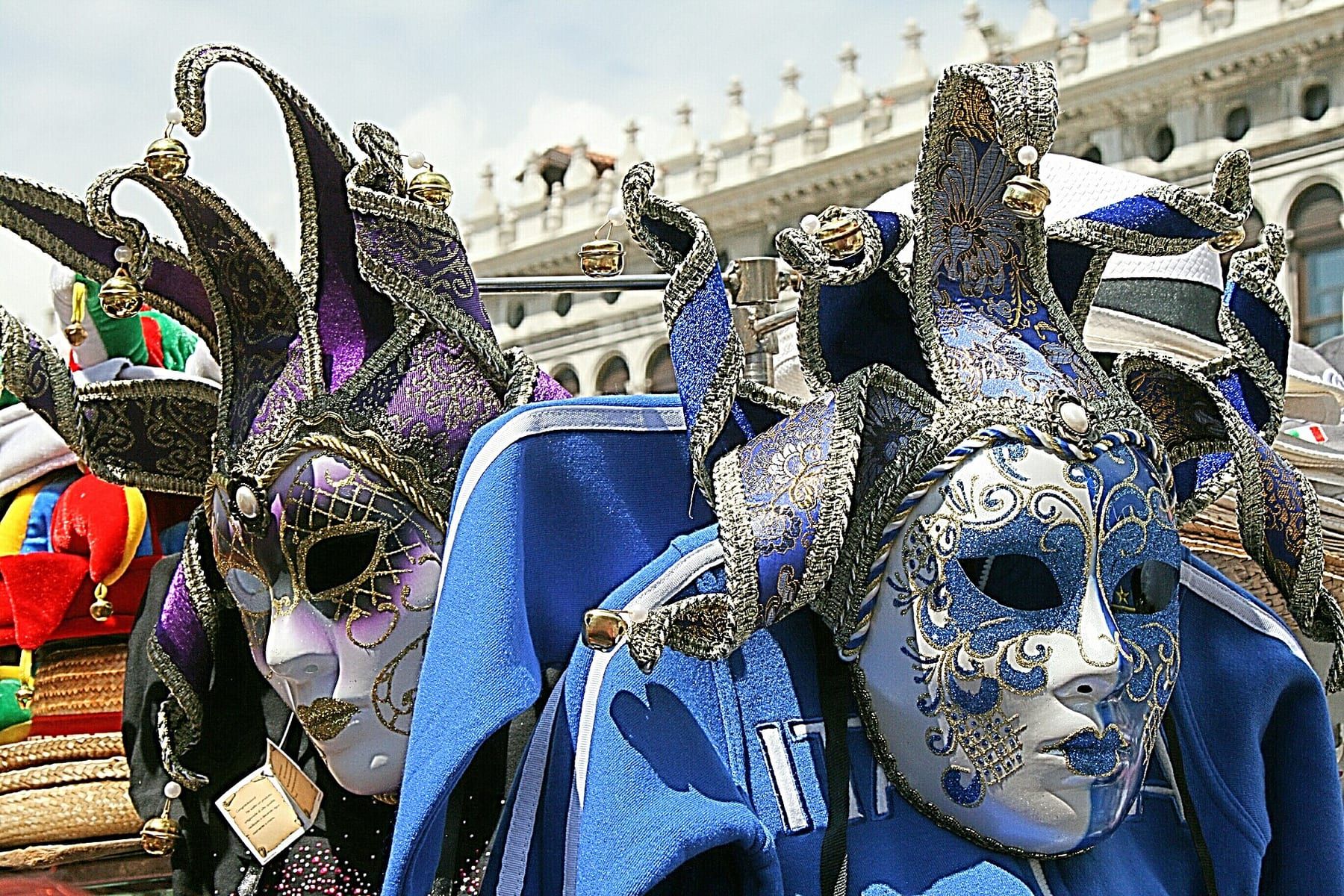
The Venice Carnival is the city’s most famous festival: for a little over two weeks every winter, the alleys and squares fill with masks and costumes, boat processions glide along the Grand Canal and St Mark’s Square becomes an open-air stage. It always ends on Shrove Tuesday (Martedì Grasso), the day before Ash Wednesday. Almost everything that happens in the streets is free; you pay for balls in palaces, costumed dinners, mask-making workshops and, above all, for a place to sleep in the city on those days.
Here’s how the dates are worked out, which events come back every year, how to choose a mask, what the balls cost and how to enjoy Carnival without spending the day in a queue.
When is Carnival?
Carnival has no fixed dates: it depends on Easter. Shrove Tuesday falls 47 days before Easter Sunday, so always between 3 February and 9 March. In recent editions the festival has started on a Saturday, 17 days earlier, which means it spans three weekends. In practice the Venice Carnival takes place between late January and early March.
To work out your dates: find Easter in the year of your trip, subtract 47 days and you have Shrove Tuesday. The detailed programme, with the theme chosen for each edition, appears on the official site carnevale.venezia.it a few weeks before; the dates of the next edition usually show on its home page many months ahead.
A little history
The Venetian Carnival has medieval roots, and in the 18th century it lasted for months: masks allowed nobles and commoners to mingle without being recognised. With the fall of the Republic in 1797 the festival all but died out. It was revived in 1979 by local associations and has since become an international event, with a different theme every year.
Events that return every year
The programme changes with each edition, but some events come back every time, on roughly the same days.
| Event | Usually when | Where | Access |
|---|---|---|---|
| Venetian water festival | First weekend | Rio di Cannaregio | Free |
| Choosing the 12 Marie | First Saturday | Scuola Grande di San Giovanni Evangelista | Free, limited space |
| Flight of the Angel | First Sunday, around midday | From the bell tower to St Mark’s Square | Free, square often capped |
| Procession of the Marie | Second Saturday | From Santa Sofia to San Marco | Free |
| Best mask contest | Almost daily | Stage in St Mark’s Square | Free |
| Election of the Maria of the Year | Monday before Shrove Tuesday | Venue given in the programme | Depends on the event |
| Svolo del Leon and closing | Shrove Tuesday, afternoon | St Mark’s Square | Free |
| Official dinner show | Various evenings | Ca’ Vendramin Calergi | Paid, on the official site |
| Private balls | Various evenings | Palaces on the Grand Canal | Paid, often costume required |
Festa delle Marie
This is the historical heart of Carnival. It recalls the kidnapping of twelve Venetian brides by pirates in 973 and their rescue under Doge Pietro Candiano III. The festival was revived in 1999. On the first Saturday the twelve Marie are chosen at the Scuola Grande di San Giovanni Evangelista; the following Saturday they parade in a procession of boats from Santa Sofia to San Marco, in historical dress. On the Monday before Shrove Tuesday the Maria of the Year is elected, and she is proclaimed in St Mark’s Square on the final day.
Flight of the Angel
The most photographed moment. Around midday on the first Sunday, a costumed figure glides down a cable stretched from the belfry of the St Mark’s bell tower to the stage in the square, above thousands of people. The flyer is normally the previous year’s Maria. The tradition goes back to the 16th century, when the flyer was an acrobat. In some editions the Flight has been cancelled or moved because of works on the bell tower or the square: check that year’s programme. According to various sources, a second flight, the Flight of the Eagle (Volo dell’Aquila), takes place on the last weekend, but not every edition includes it.
Water parades and the closing
On the first weekend the Rio di Cannaregio fills with decorated boats and masks for the opening festival. On the last day, Shrove Tuesday, the Svolo del Leon in St Mark’s Square officially closes Carnival as the banner of the lion of St Mark is raised up the bell tower.
The mask contest
Almost every day, costumes competing for the best mask parade across the stage in St Mark’s Square. They represent months of work, often hand-sewn: even if you’re not taking part, it’s a show worth stopping for.
Balls and masked dinners
For the evenings there are two levels. The Carnival’s official dinner show takes place at Ca’ Vendramin Calergi, the Grand Canal palace that now houses the Casino, and is booked through the official site.
Then there are the private balls in palaces, organised by costume ateliers and associations. The most famous, the Ballo del Doge at Palazzo Pisani Moretta, costs from about €800 to €5,000 per person depending on the package, according to unofficial sources, with costume hire, around €700, on top. The same palace also hosts the Ballo Tiepolo, with dinner. For almost all balls period costume is required or strongly expected, and places sell out months ahead.
On a tighter budget, many baroque ensembles offer Carnival concerts in costume, and La Fenice programmes themed performances: see our theatres and concerts guide.
Masks: the classic types and where to buy them
Traditional Venetian masks have specific names and roles:
- Bauta: the white mask covering the whole face, with a jutting chin that lets you eat and drink without removing it. It was worn with a tricorn hat and the tabarro, a black cloak.
- Moretta: a small oval mask of black velvet, with no mouth, which women held in place by gripping a button between their teeth; the wearer remained silent.
- Colombina: the decorated half-mask covering only the eyes, linked to the commedia dell’arte.
- Plague doctor (medico della peste): the mask with the long beak, inspired by the garb of doctors during epidemics.
The plastic masks on street stalls are almost always imported. Authentic ones are papier-mâché, shaped on moulds and painted by hand by the mascareri, in workshops where you can see the bench. They cost more, but every piece is different and lasts for years.
Mask-making workshops
The best way to take home a real mask is to decorate one yourself. On Tiqets, the mask-making workshop, a short walk from St Mark’s Square, lasts 1 hour 15 minutes, costs €77 and is rated 4.7: a Venetian mask decorator explains the history of masks, provides all the materials and hands you a certificate at the end. It runs all year round and works well for families too.
During Carnival there’s also a digital treasure hunt (€24 on Tiqets) that guides you through alleys and over bridges with an app and ends with a 20-minute mask workshop and a mask to keep; it still has very few reviews.
-
from €77 per person
Book on Tiqets -
from €24 per person
Book on Tiqets
Carnival sweets
Carnival is also something you eat. Pastry shops and bars fill up with frittelle, the festival’s signature sweet: the classic Venetian version has raisins and pine nuts, but you’ll also find them filled with custard or zabaglione. Alongside them are galani, thin fried pastry ribbons dusted with icing sugar. They’re seasonal: once Carnival is over they vanish from the windows, so make the most of them with a mid-morning coffee, away from the queues at the bars around San Marco.
Crowds and practical tips
- Pick the right days: the last two weekends and Giovedì Grasso are the busiest. Weekdays in the first week are far more manageable.
- Capped entry to St Mark’s Square: on peak days access to the square can be limited, with entry gates and one-way routes. The rules change every edition and are published on the official site.
- Accommodation: central hotels fill up and prices rise sharply. Book months ahead, or stay in Mestre or on the Lido, linked by train and waterbus.
- Waterbuses: on the big days the lines to San Marco are packed; walking is often quicker. An ACTV pass saves you queuing at the ticket machines.
- Cold and acqua alta: February is cold and damp, and when the tide is high St Mark’s Square is among the first places in the city to flood. Bring waterproof shoes.
- Photographing masks: people in costume are happy to pose, but ask with a gesture and don’t block the way. The best photos come at dawn, between San Zaccaria and St Mark’s Square, before the crowds.
- Dress up yourself: you can hire period costume from ateliers in the city; for a ball, book it together with your ticket.
- Access fee: so far the day-tripper access fee calendar has covered spring and summer, not Carnival. Check cda.ve.it anyway (access fee guide).
Visiting out of season
Carnival itself only happens between January and March, but the spirit of the masks is there all year: the mask-making workshop is always open, the mascareri work in every season, and our Venice in winter guide covers the quieter months leading up to the festival.
Book the mask-making workshop on Tiqets from €77 · ★ 4.7
Frequently asked questions
When is the Venice Carnival?
It always ends on Shrove Tuesday, 47 days before Easter, so between 3 February and 9 March. In recent editions it has started on a Saturday 17 days earlier, so the festival runs from late January to early March. Exact dates are on carnevale.venezia.it.
Is the Venice Carnival free?
Events in St Mark's Square and the campi are mostly free. You pay for private balls in palaces, the official dinner show and workshops. On the busiest days access to the square may be capped, with one-way routes.
What is the Flight of the Angel?
A costumed figure descends on a cable from the St Mark's bell tower to the stage in the square, usually around midday on the first Sunday of Carnival. The flyer is normally the previous year's Maria. In some editions it has been cancelled or changed because of works on the bell tower or the square.
What is the Festa delle Marie?
It recalls twelve Venetian brides kidnapped by pirates and rescued under Doge Pietro Candiano III. The twelve Marie are chosen on the first Saturday, parade in a boat procession from Santa Sofia to San Marco, and the Maria of the Year is proclaimed in the square on Shrove Tuesday.
How much does a masked ball in Venice cost?
Private balls are expensive: according to unofficial sources the Ballo del Doge at Palazzo Pisani Moretta ranges from about €800 to €5,000, with costume hire, around €700, on top. Almost all balls require period costume.
Where can I buy an authentic Venetian mask?
From the workshops of the mascareri, who shape papier-mâché and paint by hand, easy to spot by the open workbench. The plastic masks on street stalls are almost always imported. A 75-minute class on Tiqets costs €77 and lets you decorate your own.
Do I pay the access fee during Carnival?
So far the day-tripper access fee calendar has mostly covered spring and summer, not the Carnival period. The calendar changes every year: check cda.ve.it before you travel.
Which are the busiest days?
The last two weekends, Giovedì Grasso (the Thursday before the end) and Shrove Tuesday. Weekdays in the first week are far more relaxed, and early morning is the calmest time to photograph the masks.