Ca’ Pesaro and Ca’ Rezzonico are two civic museums on the Grand Canal, both designed by Baldassare Longhena in the 17th century, and they tell the story of two very different Venices. Ca’ Pesaro, the main modern art museum in Venice, stands in Santa Croce: Klimt, Rodin, Kandinsky, the Futurists and the great Venetian scene of the 20th century, with the Museum of Oriental Art on the top floor as a bonus. Ca’ Rezzonico, in Dorsoduro, is the Museum of 18th-Century Venice: a noble palace furnished as it was in the days of Goldoni and Casanova, with frescoes, period furniture and paintings by Canaletto, Longhi and Tiepolo.
You can see them on single €15 tickets, with two €20 themed combos or with the Museum Pass. Below you’ll find official and online prices side by side, the notices currently in force, what to see floor by floor and how to pair them with the nearby museums: Palazzo Mocenigo, Casa Goldoni and Museo Fortuny.
Tickets and prices: official vs Tiqets
Both museums belong to the MUVE network (Fondazione Musei Civici di Venezia) and share the same price structure. The reduced rate applies to children aged 6–14, students aged 15–25, over-65s and Rolling Venice card holders. Entry is free for children under 6, residents of the Comune di Venezia and visitors with disabilities plus a companion. Online you can only buy the age-based reductions; other concessions are issued at the ticket desk on showing a document. The MUVE app audio guide is included in the price.
| Ticket | What it covers | Official (MUVE) | Tiqets |
|---|---|---|---|
| Ca’ Pesaro | Modern Art Gallery + Museum of Oriental Art | €15 / €7.50 | €15 |
| Ca’ Rezzonico | Museum of 18th-Century Venice | €15 / €7.50 | €15 |
| Musei del Settecento Veneziano | Ca’ Rezzonico, Palazzo Mocenigo, Casa di Goldoni · 3 months | €20 / €10 | €20 |
| Musei del Moderno e Contemporaneo | Ca’ Pesaro, Museo Fortuny, MUVEC in Mestre · 3 months | €20 / €10 | €20 (Ca’ Pesaro and Fortuny) |
| Museum Pass | twelve civic venues, Doge’s Palace included · 6 months | €50 / €25 | €50 |
Prices can change: check the official website before you pay.
Tiqets or the official site? The prices are identical here, so it comes down to the conditions. The single “fast track” tickets for Ca’ Pesaro and Ca’ Rezzonico on Tiqets are non-refundable. The Settecento combo on Tiqets, on the other hand, comes with free cancellation up to the day before, a real advantage if your dates aren’t fixed. The Moderno combo on Tiqets is non-refundable and its listing names only Ca’ Pesaro and Fortuny, while the official ticket also includes MUVEC. On an off-season weekday you can simply buy at the door: these two museums rarely see queues anything like those at St Mark’s.
-
from €15 per person
Book on Tiqets -
from €15 per person
Book on Tiqets -
from €20 per person
Book on Tiqets -
from €20 per person
Book on Tiqets
Which combination to choose
- Just one of the two: a single €15 ticket.
- Ca’ Rezzonico plus Palazzo Mocenigo: the Settecento combo (€20) costs less than the two separate tickets (€30) and throws in Casa Goldoni.
- Ca’ Pesaro plus Museo Fortuny: the Moderno combo (€20) instead of €30.
- Both Ca’s plus the Doge’s Palace: the €50 Museum Pass already pays for itself (€35 + €15 + €15 = €65), and it lasts six months. The full sums are on the passes and combos page.
- Both Ca’s without the Doge’s Palace: two single tickets (€30), or both combos (€40) if you add at least Mocenigo and Fortuny.
Ca’ Pesaro: what to see
Longhena designed the palace for the Pesaro family from 1659, and Antonio Gaspari completed it in 1710. In 1898 Duchess Felicita Bevilacqua La Masa left it to the city, and in 1902 the International Gallery of Modern Art opened here, set up to support young artists. Since then, purchases made at the Biennale have brought to Venice works that would otherwise have gone elsewhere.
Highlights of the collection, according to the museum:
- Gustav Klimt, Judith II (Salome) (see the notice below);
- Auguste Rodin, The Thinker;
- Wassily Kandinsky, Kleine Welten I;
- Medardo Rosso, Umberto Boccioni, Felice Casorati, Gino Rossi, Arturo Martini;
- more than forty sculptures by Adolfo Wildt;
- Morandi, de Chirico, Carrà, Miró, Matta, Schiele, Klee;
- from the post-war years, Rauschenberg, Twombly and Marina Abramović’s Balkan Baroque.
The Museum of Oriental Art
On the top floor, and included in your ticket, is a state museum that many visitors stumble upon by chance. It grew out of the collection of Enrico di Borbone, Count of Bardi, assembled on a long journey through Asia between 1887 and 1889, about nine months of it in Japan. There are tens of thousands of objects: samurai arms and armour, lacquerware and porcelain, with pieces from China and Indonesia as well. It is regarded as one of Europe’s most important collections of Japanese art from the Edo period.
Current notices at Ca’ Pesaro
At the time of writing, the museum reports that Klimt’s Judith II is out on loan to another exhibition and that rooms 6 and 7 are closed for rehanging. If you’re coming specifically for the Klimt, check the notices page on capesaro.visitmuve.it before you buy: the ticket stays full price even with some rooms closed.
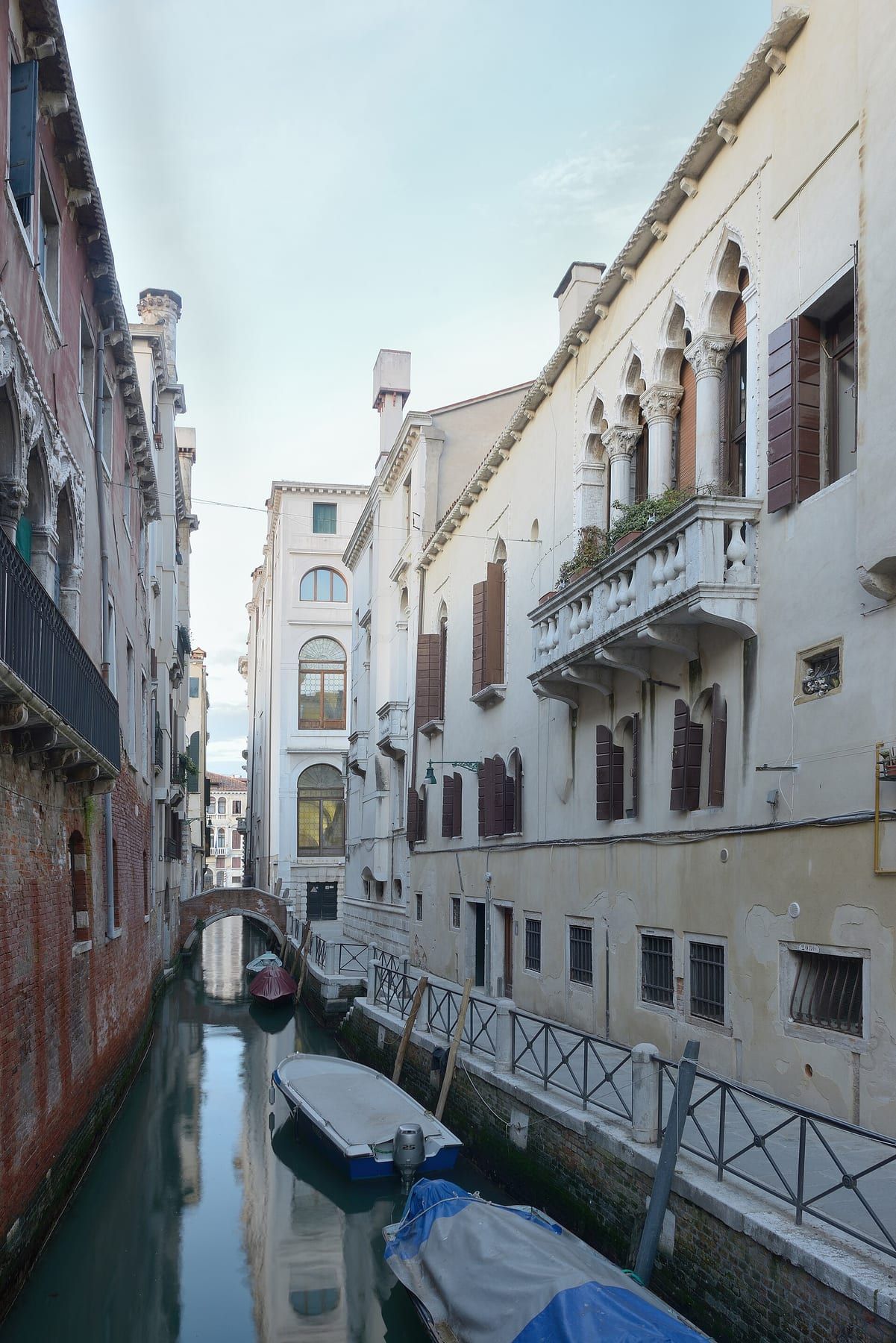
Ca’ Rezzonico: what to see
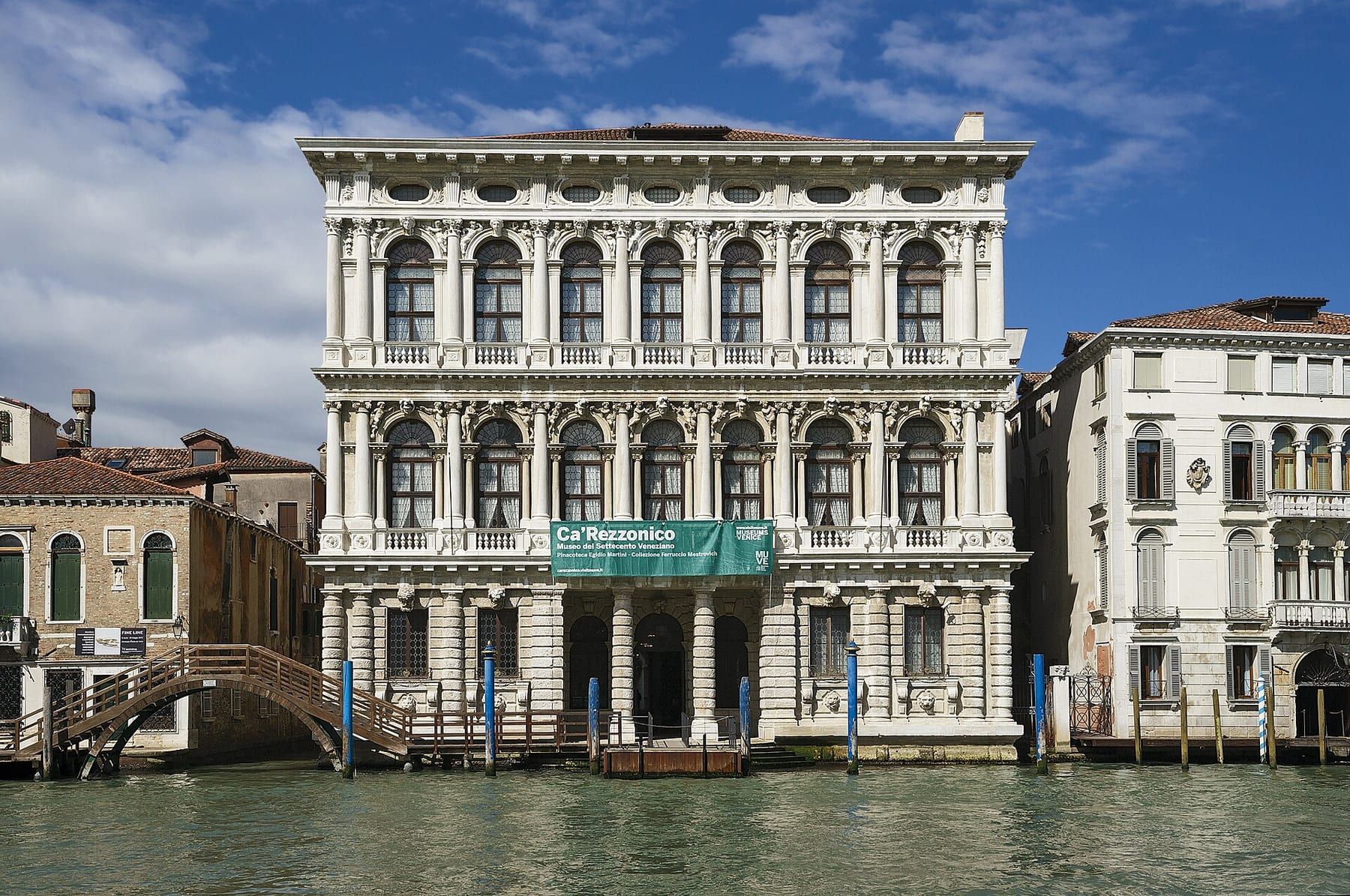
Ca’ Rezzonico also began as a Longhena design, commissioned by Filippo Bon in the 1650s and left unfinished when he died in 1682. Giambattista Rezzonico bought it in 1750 and Giorgio Massari completed it by 1756. Two years later Carlo Rezzonico became Pope Clement XIII. The poet Robert Browning died here in 1889, and Cole Porter rented it in the 1920s. The city bought it in 1935 to house its 18th-century museum.
The route, floor by floor:
- Ground floor: a 19th-century gondola with its felze, the closed cabin that sheltered passengers, and the way out to the garden.
- First floor: Massari’s grand staircase leads up to the ballroom and eleven rooms with frescoed ceilings and 18th-century Venetian furniture.
- Second floor: the portego holds two early Canalettos. Then come the Pietro Longhi rooms, with his scenes of everyday Venetian life, and Giandomenico Tiepolo’s frescoes, detached from the family villa at Zianigo and reassembled here.
- Third floor: the old “Ai Do San Marchi” pharmacy, rebuilt with its original jars and fittings, the Egidio Martini picture gallery and the Mestrovich collection, with works by Rosalba Carriera, Tintoretto and Bonifacio de’ Pitati.
Current notice at Ca’ Rezzonico
At the time of writing, a large structural scaffold stands in the ballroom and limits the view of Giovanni Battista Crosato’s ceiling fresco. The rest of the route is open. If the ballroom matters to you, check the museum website to see whether the work is still under way.
Opening hours and closing days
- Summer hours: 10:00–18:00. Winter hours: 10:00–17:00. Last entry is one hour before closing.
- Summer late openings: usually from 1 May to late September, both museums stay open until 20:00 on Fridays and Saturdays. The exact dates change every year.
- Weekly closures: Ca’ Pesaro on Mondays, Ca’ Rezzonico on Tuesdays. To see both on the same day, go between Wednesday and Sunday.
- With at least five working days’ notice, MUVE can also arrange paid private openings after closing time.
Getting there
Both museums have their own stop on vaporetto line 1, the one that runs the length of the Grand Canal.
- Ca’ Pesaro: San Stae stop. From the landing it’s a few minutes’ walk; follow the signs to the museum.
- Ca’ Rezzonico: Ca’ Rezzonico stop, practically at the entrance. On foot it’s about 10 minutes from the Accademia or from Campo Santa Margherita.
- From one museum to the other: line 1 links San Stae and Ca’ Rezzonico with no change, passing Rialto. On foot you cross San Polo and the Rialto area: a lovely walk, but allow at least half an hour.
A single ACTV ticket costs €9.50 and lasts 75 minutes, so if you’re moving around a lot a travel pass works out cheaper. Everything is on the ACTV vaporetto page. If you have luggage or little time, a water taxi can drop you at the canal-side landing.
Practical tips
- Time: an hour and a half to two hours for Ca’ Rezzonico. Allow the same for Ca’ Pesaro if you want to give the Museum of Oriental Art its due.
- Luggage: backpacks and medium bags go in the free cloakroom. Suitcases, trolleys and bags whose three sides add up to more than one metre are refused: leave them at your hotel or in left luggage.
- Families: under the MUVE “Seniors + Junior” offer, in a group of 2 adults with at least one young person up to 16, every paying member gets the reduced rate. At Ca’ Rezzonico children usually stop at the gondola and the pharmacy; at Ca’ Pesaro, at the Japanese armour.
- Summer: the Friday and Saturday late openings until 20:00 let you visit after the hottest hours and see the Grand Canal from the windows in the late-afternoon light.
The other 18th-century and modern museums
The two themed combos only make sense if you add at least one more museum. Here’s what they are and where to find them.
- Palazzo Mocenigo (Santa Croce 1992, San Stae stop, €15, closed Mondays). Close to Ca’ Pesaro, it was the home of the family that gave the Republic seven doges. It holds the Museum of Textiles and Costume, with mannequins in period dress in a layout by Pier Luigi Pizzi, and a section on perfume with more than 200 essences to smell. Part of the Settecento combo.
- Casa di Carlo Goldoni (San Polo 2794, San Tomà stop, €7, closed Wednesdays). The playwright’s birthplace: small, but accessible with a lift. Short hours: 10:00–16:00. Part of the Settecento combo.
- Museo Fortuny (Campo San Beneto, Sant’Angelo stop, €15, closed Tuesdays). The Gothic palace where Mariano Fortuny lived and worked: painting studio, theatre models, printed fabrics, lamps and gowns. Part of the Moderno combo.
An easy Settecento day: Palazzo Mocenigo in the morning, lunch between San Stae and Rialto, Casa Goldoni in the early afternoon (it closes early) and Ca’ Rezzonico last. For the Moderno combo: Ca’ Pesaro in the morning, then the vaporetto to Sant’Angelo for Fortuny.
Nearby
From Ca’ Rezzonico you’re in the heart of Dorsoduro: in ten minutes you reach the Gallerie dell’Accademia, and a little further on is the Peggy Guggenheim Collection. Campo Santa Margherita is the place for a spritz afterwards. From Ca’ Pesaro, head down to the Rialto market and the Grand Canal, or carry on to the Frari and Titian’s Assumption. For the full picture, see the guide to museums in Venice.
Check the Settecento combo on Tiqets from €20 · ★ 4.6
Frequently asked questions
How much does Ca' Pesaro cost?
The official ticket is €15 full and €7.50 reduced (ages 6–14, students 15–25, over-65s), and it includes the Museum of Oriental Art on the top floor. Tiqets charges the same €15.
Is the Klimt at Ca' Pesaro on display?
At the time of writing, Klimt's Judith II is out on loan and rooms 6 and 7 are closed for rehanging. Check the notices on capesaro.visitmuve.it before you go if the Klimt is your main reason to visit.
Is the Musei del Settecento Veneziano combo worth it?
Yes, if you visit at least Ca' Rezzonico and Palazzo Mocenigo: separately they cost €30, the combo €20, and it adds Casa Goldoni (€7). It is valid for 3 months, with one entry per museum.
Are Ca' Pesaro and Ca' Rezzonico included in the Museum Pass?
Yes. The €50 MUVE Museum Pass covers both, plus the Doge's Palace, Mocenigo, Goldoni, Fortuny, the Glass Museum and other civic museums, with one entry each over 6 months.
Which days are they closed?
Ca' Pesaro closes on Mondays and Ca' Rezzonico on Tuesdays. To see both on the same day, pick any day from Wednesday to Sunday.
How do I get to Ca' Rezzonico by vaporetto?
Take line 1 to the Ca' Rezzonico stop, right in front of the palace. For Ca' Pesaro the stop is San Stae, also on line 1, a few minutes' walk away.
Can I bring a backpack or suitcase?
Backpacks and medium bags go in the free cloakroom. Suitcases, trolleys and bulky bags over one linear metre (the three sides added together) are not accepted at any civic museum.
How long do I need for each?
Allow about an hour and a half to two hours for Ca' Rezzonico, which spreads over three floors, and the same for Ca' Pesaro if you want to see the Museum of Oriental Art properly too.
Official sources
- MUVE — Tickets and passes
- Ca' Pesaro — Visitor information
- Ca' Pesaro — Layout and collections
- Ca' Pesaro — The museum
- Ca' Rezzonico — Visitor information
- Ca' Rezzonico — Layout and collections
- Ca' Rezzonico — The museum
- Palazzo Mocenigo — Building and history
- Casa di Carlo Goldoni — Tickets
- Museo Fortuny — Building and history