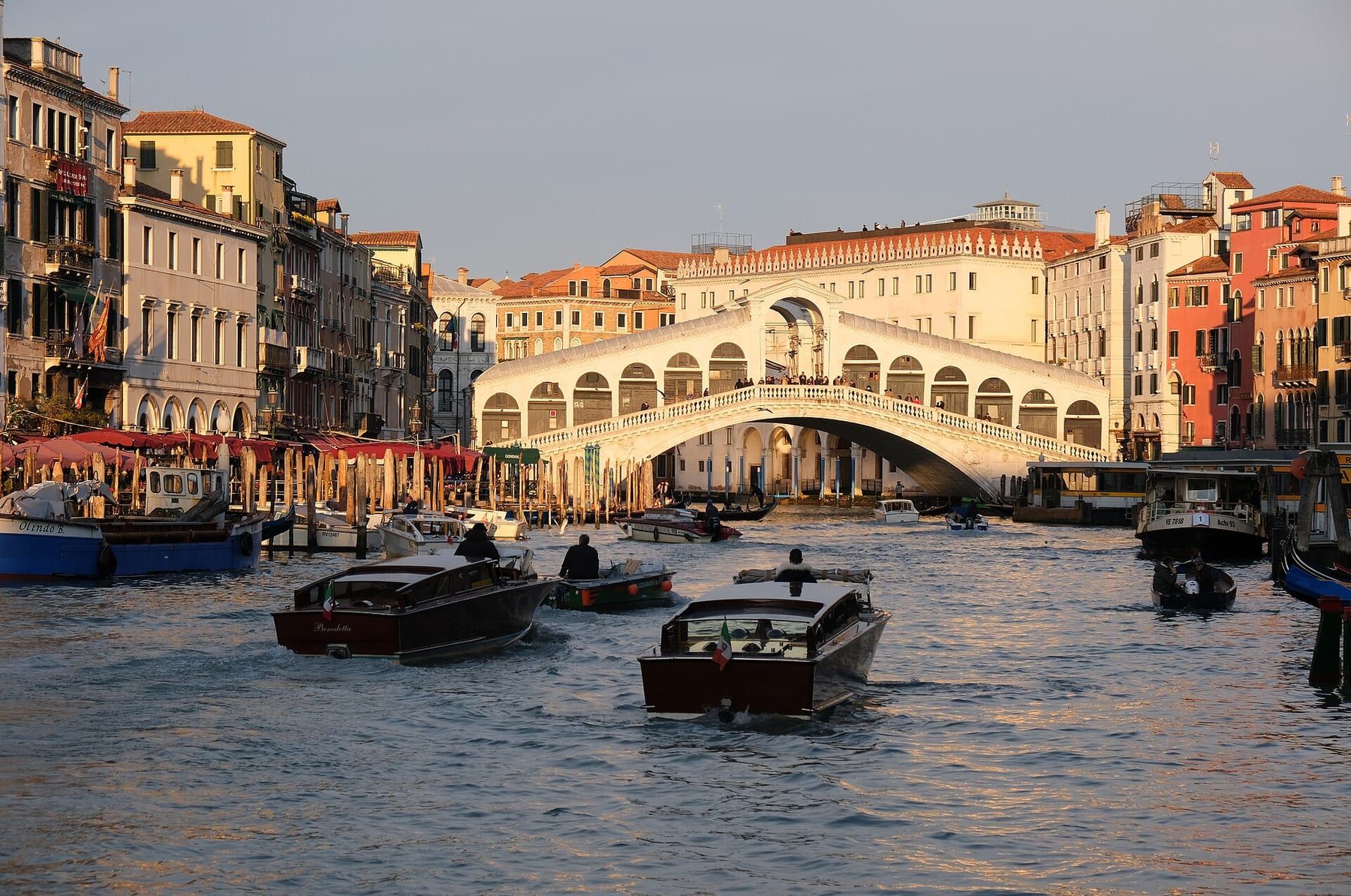
The Rialto Bridge and the Grand Canal are Venice’s postcard, and both are free. The bridge is a public street, shops and all, open day and night. The canal you can see from the embankments and its four bridges, but to really experience it you need to get on the water. The cheapest way isn’t a gondola: it’s vaporetto line 1, which runs up the whole canal calling at every stop for €9.50. The shortest is the traghetto, a gondola that ferries you from one bank to the other for €2.
This guide brings together everything around the Rialto: the history of the bridge and its shops, the market and its days, the Fondaco dei Tedeschi (and why the terrace can’t be visited today), the vaporetto ride with the stops worth knowing, the palaces to recognise from the water, and the traghetti. Prices and hours were checked at the last update and can change.
The Rialto Bridge: history and shops
The Rialto is where Venice was born as a city of merchants: here, on the highest bank of the canal (the name comes from rivo alto, “high bank”), banks, money-changers and warehouses clustered together. For centuries the Grand Canal was crossed on a bridge of boats, then on a series of wooden bridges, with a movable central section to let tall-masted ships through. Wood couldn’t bear the weight of the crowds, and more than one bridge collapsed or burned.
The stone bridge you see today was built between 1588 and 1591 to a design by Antonio da Ponte. The Republic had gathered proposals for decades, and tradition has it that the rejected designs included some by famous architects. The simplest and boldest solution won: a single arch of Istrian stone, resting on thousands of wooden piles driven into the mud of both banks.
The bridge has three parallel walkways. The central one, the widest, climbs in steps between two rows of shops under arches; on either side, two outer walkways run along the balustrades, from which you look out over the canal. At the top, in the middle, a large arch opens the view in both directions. The shops sell jewellery, glass, leather goods, masks and souvenirs. It’s not the place for bargains, but some are long-established businesses and worth a look.
How to enjoy it. Around midday the bridge is one of the most crowded spots in the city, with people stopping for photos on the outer walkways. For a nearly empty bridge, come before 08:30 or after dinner: the view of the lit-up canal from the top is one of the finest in Venice, and it’s free. Keep to the right, don’t stop on the central steps and don’t sit down: city rules forbid it on bridges.
Where to photograph it. From the Riva del Vin, on the San Polo side, you see the bridge with the palaces of San Marco behind it; from the Riva del Ferro, on the opposite side, you see it with the Palazzo dei Camerlenghi. The best photo, though, is from the water: from a vaporetto arriving from Ca’ d’Oro, the bridge appears at the end of the canal’s bend.
The Rialto market
Across the bridge, on the San Polo side, is the Rialto market, one of the few places in the historic centre where Venetians still do their shopping. It has two parts:
- Erbaria, fruit and vegetables, along the waterfront and in the alleys behind the bridge. It usually runs Monday to Saturday mornings, roughly 07:30 to 13:00. Here you’ll find vegetables from the lagoon islands, such as Sant’Erasmo artichokes in spring.
- Pescheria, the fish market, under a neo-Gothic loggia on the canal. It usually runs Tuesday to Saturday, roughly 07:30 to midday. On Mondays the fish stalls stay closed.
On Sundays the market is closed. The best time is between 08:00 and 10:00, when the stalls are full and there are few tourists. If you’re not cooking, do as the Venetians do: after your wander, stop at a bacaro in the surrounding alleys for an ombra (a glass of wine) and some cicchetti.
Next to the market is Campo San Giacomo di Rialto, with the little church that tradition considers the oldest in the city and, opposite, the Gobbo di Rialto, the kneeling statue that supports the small stair from which the Republic’s decrees were read out. From the Pescheria the traghetto to Santa Sofia crosses to the Cannaregio bank: the handiest crossing if you’re coming from the Strada Nova.
The Fondaco dei Tedeschi: the terrace is closed
The large square building at the foot of the bridge, on the San Marco side, is the Fondaco dei Tedeschi: warehouse, office and lodging for German merchants in the days of the Republic. Its canal façade was frescoed by Giorgione and its street façade by Titian; only fragments of the frescoes survive, kept in a museum.
After its restoration, for almost a decade the building housed a luxury department store with a rooftop panoramic terrace, free with a timed booking: one of the few ways to see the Rialto from above. The store closed, the building was emptied and the terrace can no longer be visited. For now the building opens only for private events, and the owners are looking for a new operator with no set timescale. If a guide mentions “booking the terrace”, that information is out of date.
For views over Venice near the Rialto, the closest alternatives are the Scala Contarini del Bovolo (€9 on the official site, €10 on Tiqets), about 5 minutes’ walk towards Campo Manin, and the Palazzo Pisani terrace near Campo Santo Stefano (€20 on Tiqets, guided tours only). All the options are on our squares, bridges and canals page.
The Grand Canal by vaporetto: line 1
The Grand Canal is about 3.8 km long and cuts through the city in an S-shape, from Santa Lucia station to St Mark’s Basin. Its banks are lined with an almost unbroken row of palaces and churches, built over eight centuries by the Republic’s wealthiest families, who put their showpiece façades on the main waterway.
The cheapest way to see all of it is ACTV line 1. It calls at every stop from Piazzale Roma to the Lido, runs about every 12 minutes by day and costs the same as any ride: €9.50 on a 75-minute ticket, or nothing extra if you already hold a pass. From Ferrovia to the Rialto takes about 20 minutes, to San Marco Vallaresso about 35–40: the 75-minute ticket is enough, with time to spare.
| Stop | Bank | What you see |
|---|---|---|
| Piazzale Roma / Ferrovia | Santa Croce / Cannaregio | Constitution Bridge, the station, the Scalzi Bridge and Scalzi church, the green dome of San Simeon Piccolo |
| Riva de Biasio | Santa Croce | Opposite, the Fondaco dei Turchi, now the Natural History Museum |
| San Marcuola | Cannaregio | Palazzo Vendramin Calergi, home of the Casino, where Richard Wagner died |
| San Stae | Santa Croce | The Baroque façade of San Stae church and, just beyond, Ca’ Pesaro with the Modern Art Gallery |
| Ca’ d’Oro | Cannaregio | The lacy Gothic façade of the Ca’ d’Oro (the museum is closed for restoration); opposite, the Pescheria |
| Rialto Mercato | San Polo | The market and the Palazzo dei Camerlenghi |
| Rialto | San Marco | The bridge, the Fondaco dei Tedeschi, the city-hall palaces Ca’ Loredan and Ca’ Farsetti |
| San Tomà | San Polo | The volta de canal, the great bend, with Ca’ Foscari, home of the university |
| Ca’ Rezzonico | Dorsoduro | Ca’ Rezzonico, museum of 18th-century Venice; opposite, Palazzo Grassi |
| Accademia | Dorsoduro | The wooden bridge and the Gallerie dell’Accademia |
| Salute | Dorsoduro | Palazzo Venier dei Leoni (Peggy Guggenheim Collection), Ca’ Dario with its marble roundels, the Salute basilica, Punta della Dogana |
| San Marco Vallaresso / San Zaccaria | San Marco / Castello | The Basin, San Giorgio Maggiore opposite, the Doge’s Palace |
How to get the best seat. The few open-air seats are at the bow and stern. Board at the Piazzale Roma or Ferrovia termini and, if necessary, wait for the next boat: from intermediate stops you’ll nearly always find them taken. Heading towards St Mark’s, the most famous palaces are on both sides: from the bow you see them all. The best light is early morning and the hour before sunset; in the middle of the day the boats are packed with commuters and suitcases.
Line 2. It covers the same stretch with fewer stops (Ferrovia, Rialto, Accademia and San Marco Giardinetti among the main ones) and is faster. Use it to get around, not to sightsee.
Ticket or pass? If you take the vaporetto three times or more in a day, the €25 24-hour pass pays for itself. On Tiqets the “Vaporetto Pass” starts from €12 for the shortest option, compared with €9.50 for the official single ticket: check which option you’re buying. All fares, lines and luggage rules are in our ACTV vaporetto guide.
-
from €12 per person
Book on Tiqets
Palaces to spot
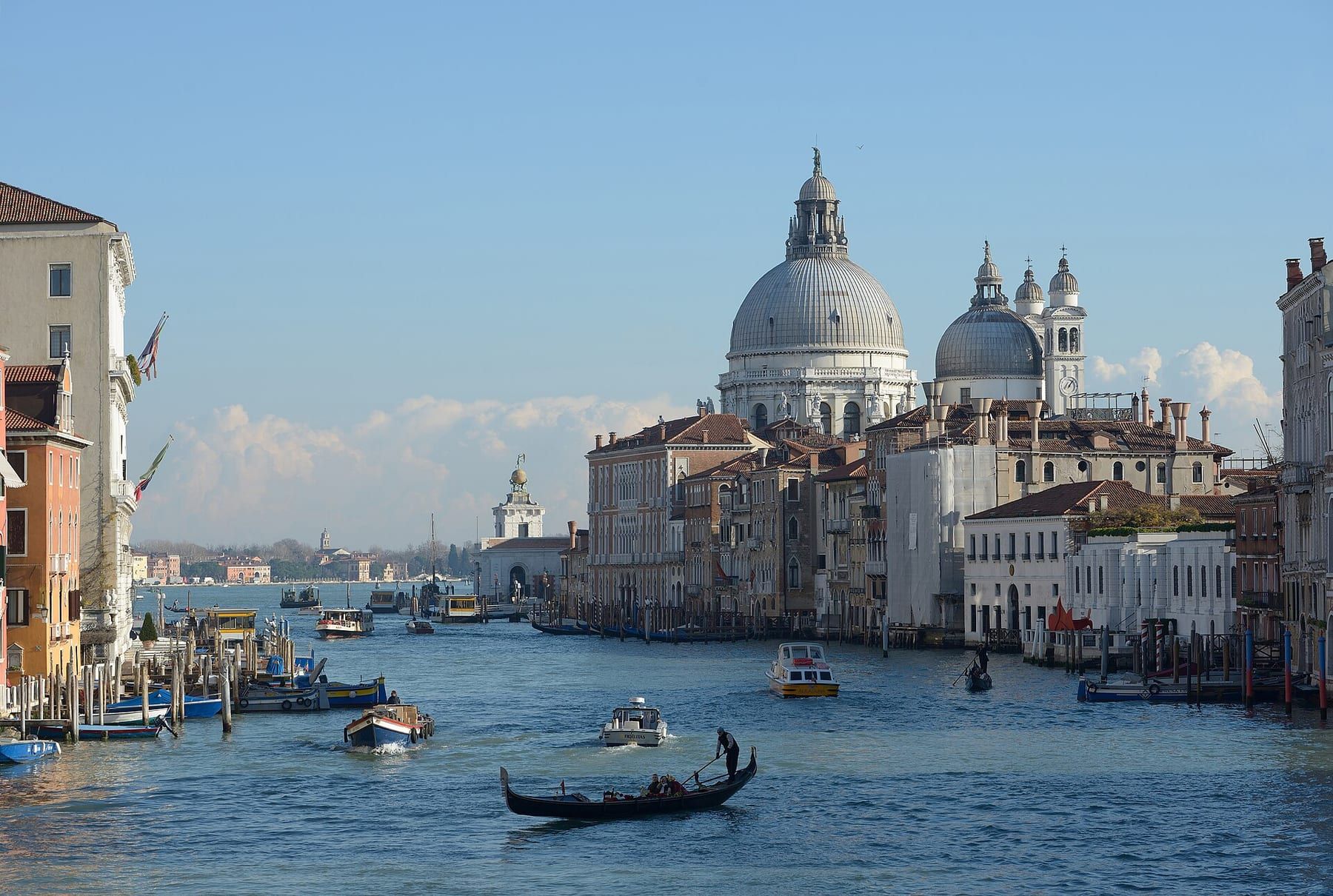
If you only have time for one stretch, choose the one from the Rialto to the Accademia: in ten minutes by vaporetto you pass some of the finest palaces. Here’s what to look for, in order, starting from the station.
- Fondaco dei Turchi. A white, two-storey arcaded loggia on the Santa Croce bank: it was the Ottoman merchants’ warehouse and now houses the Natural History Museum.
- Palazzo Vendramin Calergi. Renaissance, on the Cannaregio side, with a garden on the canal. Today it is Venice’s Casino.
- Ca’ Pesaro. Baroque, by Baldassarre Longhena, with diamond-point rustication. Modern Art Gallery and Museum of Oriental Art, both included in the MUVE Museum Pass.
- Ca’ d’Oro. The city’s most famous flamboyant Gothic palace, with an embroidered marble façade that was once gilded. The gallery inside is currently closed for restoration.
- Palazzo dei Camerlenghi. At the foot of the Rialto, on the market side: it housed the Republic’s finance magistrates.
- Ca’ Foscari. Gothic, where the canal turns: from its balcony you can see both stretches of the canal. It’s the seat of the University.
- Ca’ Rezzonico and, opposite, Palazzo Grassi. The first is the museum of 18th-century Venice; the second hosts contemporary art exhibitions.
- Palazzo Venier dei Leoni. A single storey, never completed: it’s the house-museum of the Peggy Guggenheim Collection, recognisable by its garden and the stone lions on the waterfront.
- Ca’ Dario. Small, narrow and slightly leaning, with discs of coloured marble on its façade. It has a reputation as a “cursed” palace because of the fate of its owners.
- Santa Maria della Salute and Punta della Dogana. The great Baroque votive basilica and the former sea customs house, now an exhibition space, close the canal towards the Basin.
For the museums open to the public in the canal’s palaces, see our guides to Ca’ Pesaro and Ca’ Rezzonico and the Peggy Guggenheim Collection.
The traghetto: the Grand Canal for €2
The Grand Canal has only four bridges in almost four kilometres. Where there are no bridges, Venetians have crossed for centuries by traghetto da parada: a bare gondola, with no cushioned seats, rowed by two gondoliers back and forth between two banks. The crossing takes a few minutes and costs €2 per person (€0.70 for residents), paid in cash to the gondolier. Tradition says Venetians do it standing up; if you don’t feel steady, sit on the edge, nobody minds.
The active crossings change often. According to the city’s information, the following run in the daytime, with variable hours:
- Santa Sofia–Pescaria, from the Strada Nova to the Rialto market, on weekdays;
- San Tomà–Sant’Angelo, between San Polo and the Campo Santo Stefano area, on weekdays;
- Riva del Carbon–Riva del Vin, next to the Rialto Bridge, weekday mornings only;
- Santa Maria del Giglio–Salute, in the daytime;
- Dogana, from the Vallaresso area to Punta della Dogana, in the daytime.
There’s no service on 15 August, 25 and 26 December and 1 January. Other historic crossings, such as San Samuele and San Marcuola, are reported closed. Since hours change with the seasons and the gondoliers’ availability, check the sign at the landing: if the traghetto isn’t running, the nearest bridge is usually 10–15 minutes’ walk away.
What about a gondola on the Grand Canal?
A private gondola costs €90 for 30 minutes by day and €110 for 35 minutes from 19:00, per boat with up to five people. Many rides, though, stay in the inner canals and touch the Grand Canal only briefly: if you want the canal itself, ask before boarding at the Rialto (Riva del Carbon), Santa Sofia or San Tomà stands. On Tiqets the shared “Shared Gondola Ride on Grand Canal” costs €41 per person for 30 minutes, with no commentary and help with boarding. Tariffs, stands and a comparison of the options are in our gondola guide.
-
from €41 per person
Book on Tiqets
Practical tips
- Best times. The bridge and the market before 10:00; the Grand Canal by vaporetto early in the morning or at sunset; the lit-up bridge after dinner.
- High water. The embankments around the Rialto are among the first to flood at the highest tides, usually in autumn and winter: on those days the vaporetto may skip some stops.
- Luggage. If you arrive at the station with a suitcase, line 1 carries up to three pieces per person at no extra charge, but at peak times it’s very full; line 2 is quicker.
- Eating. Around the market there are bacari and osterie that Venetians use too; on the waterfronts with a view of the bridge, prices rise.
- Access fee. On the days set by the city, day visitors must pay it before entering the historic centre: all the rules are on our access fee page.
Nearby
From the Rialto Bridge you’re about 10 minutes’ walk from St Mark’s Square following the yellow “Per S. Marco” signs, and 5 minutes from the Scala Contarini del Bovolo. On the San Polo side, in 10–15 minutes you reach Campo San Polo and the Frari basilica with Titian’s Assumption, both covered in our Castello and San Polo guide. From the market, the Santa Sofia traghetto takes you to the Strada Nova, Cannaregio’s main street towards the station.
Frequently asked questions
Do you have to pay to cross the Rialto Bridge?
No, the Rialto Bridge is a public street, free and open at any hour. The shops on the bridge keep normal shop hours, usually from morning to evening.
What is the cheapest Grand Canal cruise?
Vaporetto line 1, which runs the whole canal and calls at every stop: from Ferrovia to San Marco Vallaresso takes about 35–40 minutes on a single €9.50 ticket, valid for 75 minutes.
Which days is the Rialto market open?
The Erbaria, for fruit and vegetables, usually runs Monday to Saturday mornings; the Pescheria from Tuesday to Saturday until about midday. The market is closed on Sundays, and there's no fish on Mondays.
Is the Fondaco dei Tedeschi terrace open?
No. The free rooftop terrace was part of the department store that occupied the building, and it closed along with it. The building currently opens only for private events; check local news before counting on it.
How much does the traghetto across the Grand Canal cost?
€2 per person, paid in cash to the gondolier. The most convenient crossing for visitors is Santa Sofia–Pescaria, linking the Strada Nova with the Rialto market, which runs in the daytime.
What's the difference between line 1 and line 2 on the Grand Canal?
Line 1 stops everywhere and is the slowest, ideal for looking at the palaces. Line 2 skips many stops and gets to the Rialto, the Accademia and St Mark's sooner. The ticket is the same.
Where is the best spot to photograph the Rialto Bridge?
From the waterfronts on either side, the Riva del Vin on the San Polo side and the Riva del Ferro on the San Marco side, or from a vaporetto arriving from Ca' d'Oro. Early in the morning the bridge is almost empty.
How long is the Grand Canal?
About 3.8 km, running in an S-shape from the station to St Mark's Basin. It's crossed by four bridges: Constitution, Scalzi, Rialto and Accademia.