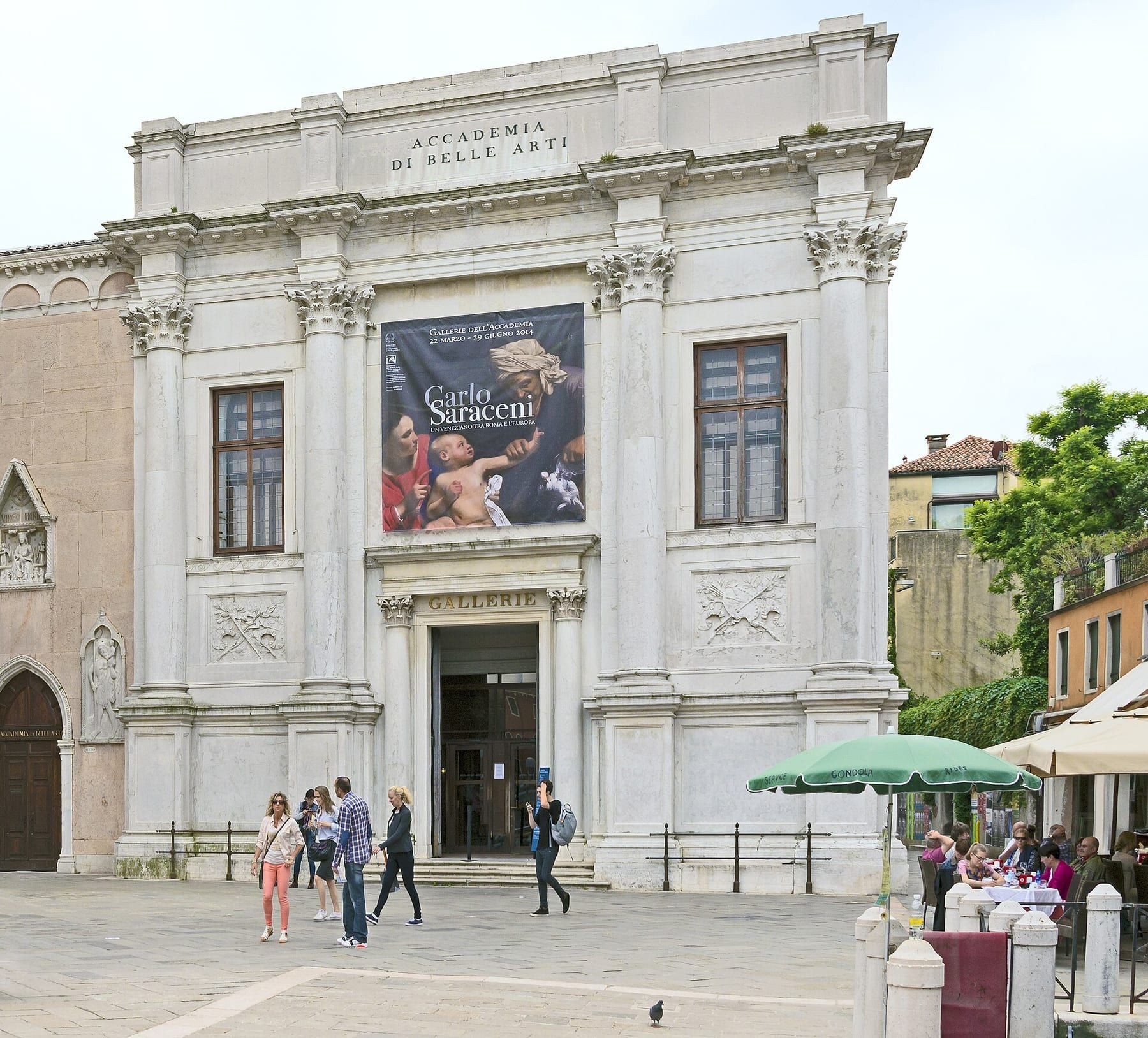
The Gallerie dell’Accademia di Venezia is the museum where Venetian painting finally makes sense, from the gold-ground panels of the fourteenth century to the eighteenth century of Tiepolo and Canaletto. It stands in Dorsoduro, in Campo della Carità at the foot of the Accademia Bridge, and fills a complex of three historic buildings: the church of Santa Maria della Carità, the convent of the Lateran Canons and the Scuola Grande della Carità, one of the city’s oldest confraternities. Its 37 rooms hold Giovanni Bellini, Giorgione, Titian, Tintoretto, Veronese, Carpaccio and many more.
Don’t confuse it with other Italian “Accademia” museums better known for sculpture: the Venice gallery is a picture gallery with an identity all its own. If you have already seen Venice’s churches and the Doge’s Palace, this is where you find the paintings that explain everything else: the colours, the light, the processions in St Mark’s Square, the city as it looked five hundred years ago.
Tickets and prices
The Gallerie is a state museum run by the Italian Ministry of Culture. That is why its prices differ from those of the Civic Museums: it is not included in the MUVE Museum Pass or in the St Mark’s Square Museums ticket. All prices can change, so check the official website before you pay.
| Ticket | Official price | Notes |
|---|---|---|
| Full | €20 | aged 18 and over (26 and over for EU citizens) |
| EU citizens aged 18–25 | €2 | with ID |
| Under 18 | free | any nationality |
| Arteritivo (ages 26–35) | €15 | Fridays 17:15–19:00 |
| Dorsoduro Museum Mile | €17 | with a paid ticket from a partner museum within 7 days |
| “Insieme” groups (10–25 people) | €17 each | by reservation |
| First Sunday of the month | free | for everyone |
| Audio guide | €6 | optional |
Free entry. On the first Sunday of every month entry is free, as at all Italian state museums. The same applies on some national days listed by the museum, including 25 April, 2 June and 4 November. ICOM members and holders of the membership cards listed on the website also go free. Long queues can build up on free Sundays, so avoid them if you can or arrive when the doors open at 9:00.
Young Europeans pay €2. It is one of the best-value tickets in Venice: if you are an EU citizen aged 18–25, bring ID. Under-18s go free whatever their nationality, so for a family with teenagers only the adults pay.
Where to buy: TicketOne is the only official online channel
The museum says it plainly: TicketOne is the only authorised reseller for online tickets. If you find entry to the Gallerie elsewhere at a higher price, it usually includes an extra service such as a guided tour, so check exactly what you are paying for. Some sources mention a small booking fee for online purchases. Alternatively, you can book by phone on 800 150 666 from Italy or +39 041 5243354 from abroad, every day from 9:00 to 18:00, or buy directly at the ticket office.
Booking is worth it at weekends, at Easter, in summer and during the Biennale months; on a Tuesday in November you can simply turn up at the desk.
Guided tours
There is no Accademia ticket on Tiqets. If you would rather have a guided tour, perhaps combined with a walk around Dorsoduro, you will find several options on GetYourGuide: always check that the entry ticket is included in the price and that the group is small, as under city rules guided groups in Venice may not exceed 25 people.
Opening hours: closed on Mondays
The Gallerie is open Tuesday to Sunday, 9:00 to 19:00. The ticket office closes at 18:00, and half an hour before closing staff start guiding visitors towards the exit: if you arrive at 17:30, you will have just over an hour. The museum is closed on Mondays.
Remember the Monday closure when you plan Dorsoduro: the Peggy Guggenheim Collection, five minutes’ walk away, closes on Tuesdays instead. From Wednesday to Sunday you can visit both on the same day.
The best time is the 9:00 opening, before the groups arrive, or late afternoon. On Friday evenings the Arteritivo rate makes the museum especially pleasant for visitors aged 26–35.
What to see: the gallery’s masterpieces
The route broadly follows chronology, from fourteenth-century gold-ground polyptychs to the eighteenth century. Works may be moved or lent to temporary exhibitions; the museum’s website shows for each work whether it is on display, on loan or being restored.
Giorgione, The Tempest (Room VIII)
The most enigmatic painting of the Venetian Renaissance: a landscape split by a flash of lightning, a young man standing on the left, a woman nursing a child on the right, a city in the background. Painted around 1504, it is surprisingly small, 82 by 73 centimetres, and no one has ever settled for certain what it shows. It hangs in Room VIII.
Giovanni Bellini
Bellini is the painter who brought light into Venetian painting. The Gallerie holds several of his Madonnas and the San Giobbe Altarpiece, painted around 1487 for the church of San Giobbe: its painted architecture continued the real architecture of the chapel, lit by the same light as the real windows.
Titian, Pietà
Titian’s last work, unfinished at his death and intended for his tomb in the nearby Frari basilica: dark, dramatic, painted almost with the fingers. It is one of the most moving pictures in the museum.
Tintoretto, St Mark Frees a Slave
The Miracle of the Slave is the painting that made Tintoretto famous in 1548, when he was not yet thirty. Painted for the Scuola Grande di San Marco, it shows the saint plunging from the sky to save a slave condemned to torture, as the instruments shatter before the astonished executioner and crowd.
Veronese, Feast in the House of Levi (Room X)
An immense canvas, almost as wide as the wall of Room X, with classical architecture, servants, dogs, jesters and soldiers around Christ’s table. It began life as a Last Supper and, so the story goes, was challenged by the Inquisition precisely because of those details, which were thought improper: Veronese got out of trouble by changing the title to “Feast in the House of Levi”. The same room holds other Veroneses and a Crucifixion by Tintoretto.
Carpaccio and the great narrative cycles
Vittore Carpaccio’s Legend of St Ursula is a cycle of large canvases painted for a Venetian confraternity: a Breton princess, a pilgrimage, a martyrdom, but above all Venice at the end of the fifteenth century, with its ships, costumes and buildings. In the same spirit, look for the canvases of the Miracles of the True Cross, including Gentile Bellini’s procession in St Mark’s Square and Carpaccio’s miracle set at Rialto, where you can see the old wooden bridge: true portraits of the city as it was five hundred years ago.
The eighteenth century
The last rooms bring the century of Tiepolo, Canaletto, Pietro Longhi and Rosalba Carriera, plus some works by Canova. If eighteenth-century Venice is your thing, carry on to Ca’ Rezzonico, one vaporetto stop away.
What about the Vitruvian Man?
Leonardo da Vinci’s study of the proportions of the human body, known as the Vitruvian Man, really does belong to the Gallerie dell’Accademia, which acquired it with the Bossi collection. But it is not on display: the museum explains that drawings must be protected from light and kept in a constant microclimate, which is why they are never shown permanently. The Vitruvian Man leaves storage only for rare temporary exhibitions, the most recent of them not long ago. Don’t plan your visit around seeing it: if it is ever on show, the museum announces it prominently.
History of the museum
The Gallerie was born in the early nineteenth century, in the years after the fall of the Republic of Venice in 1797. When churches, convents and confraternities were suppressed under Napoleonic rule, hundreds of paintings lost their original homes and were gathered here, in the old Scuola della Carità, alongside the Academy of Fine Arts. The museum describes itself as one of the most important “museums of political origin” of the early nineteenth century, like the Brera gallery in Milan. That is why so many works are altarpieces and large canvases made for specific places: knowing where they came from helps you read them.
Getting there
The museum is in Campo della Carità, right at the foot of the Accademia Bridge on the Dorsoduro side.
- By vaporetto: Accademia stop, served by lines 1 and 2 and, at night, line N. A single ticket costs €9.50 and is valid for 75 minutes; all the details are on our ACTV vaporetto page.
- On foot from St Mark’s: about 15 minutes via Campo Santo Stefano and across the Accademia Bridge.
- On foot from Rialto: about 20–25 minutes, again via Campo Santo Stefano.
Practical tips
- Bags: backpacks and bulky bags are not allowed. There are free lockers up to 45×35×65 cm and a free cloakroom that takes a €1 coin as a deposit, returned when you leave.
- Audio guide: €6. Especially useful for Carpaccio’s great cycles and the Veronese room.
- Time: about two hours for a full visit; an hour is enough for the main works.
- Children: under-18s go free. Carpaccio’s canvases, full of boats, dogs and characters, are perfect for a game of “spot the detail”.
- Combine with: the Peggy Guggenheim for the twentieth century, the Salute and the Zattere for a walk, Ca’ Rezzonico for the eighteenth century. The whole district is covered on our Dorsoduro page, and more ideas for the city’s museums are on our Venice museums page.
Frequently asked questions
How much is a ticket to the Accademia Gallery in Venice?
A full ticket costs €20. EU citizens aged 18–25 pay €2 and under-18s go free. On Friday evenings the Arteritivo rate for visitors aged 26–35 is €15.
When is the Accademia free?
Entry is free for everyone on the first Sunday of every month, and on some national days including 25 April, 2 June and 4 November. These days get very busy, so arrive when it opens at 9:00.
Where can I buy official tickets online?
The museum names TicketOne as its only authorised reseller for online tickets. You can also book by phone on 800 150 666 from Italy or +39 041 5243354 from abroad, daily from 9:00 to 18:00.
Is Leonardo's Vitruvian Man on display at the Accademia in Venice?
Normally not. The Vitruvian Man belongs to the Gallerie but, like all drawings, it must be kept away from light in controlled conditions, so the museum only shows it in rare temporary exhibitions.
Is the Accademia open on Mondays?
No, the museum is closed on Mondays. From Tuesday to Sunday it opens 9:00–19:00, with the ticket office open until 18:00.
How long does a visit take?
Allow about two hours for the 37 rooms, more if you linger over the huge canvases by Carpaccio and Veronese. Half an hour before closing, staff start guiding visitors towards the exit.
Can I bring a backpack?
No, backpacks and bulky bags are not allowed. There are free lockers up to 45×35×65 cm and a cloakroom that takes a €1 coin as a deposit, which you get back.
Official sources
- Gallerie dell'Accademia — Opening hours and tickets
- Gallerie dell'Accademia — Visit
- Gallerie dell'Accademia — Collections
- Gallerie dell'Accademia — The Tempest
- Gallerie dell'Accademia — Room X
- Gallerie dell'Accademia — St Mark Frees a Slave
- Gallerie dell'Accademia — Vitruvian Man
- Gallerie dell'Accademia — Dorsoduro Museum Mile