If you are looking for the glass museum in Venice, you will need a vaporetto: the Museo del Vetro is not in the historic centre but on Murano, the glassmakers’ island, about fifteen minutes by boat from Fondamente Nove. It fills Palazzo Giustinian, a Gothic building on the San Donato canal that for centuries was the residence of the bishops of Torcello. Inside is what the Venice Civic Museums Foundation (MUVE) calls the largest historical collection of Murano glass in the world, running from Roman glass of the 1st–3rd centuries AD through twentieth-century design to contemporary work.
Why go? Because Murano, explored without a compass, can shrink to a row of identical shops. The museum gives you the tools to tell a hand-blown goblet from a moulded souvenir, to understand what murrine, filigree glass and Venetian cristallo are, and to look at furnace showrooms with different eyes. It takes about an hour and a half, and it pairs easily with Burano, the Lace Museum and a glass-blowing demonstration.
Murano Glass Museum tickets and prices
The museum belongs to the Venice Civic Museums, so official tickets are sold on the MUVE website (muve.vivaticket.it) or at the desk. There are three options: the single ticket, the island combo and the Museum Pass. All prices are full adult prices and can change, so check the official site before you pay.
| Ticket | What it covers | Official price | On Tiqets |
|---|---|---|---|
| Glass Museum | the museum only, audio guide in the MUVE app included | €15 · reduced €7.50 | €15 |
| Island Museums | Glass (Murano) + Lace (Burano) + Torcello Museum, 3 months | €20 · reduced €10 | — |
| MUVE Museum Pass | all Civic Museums including the Doge’s Palace, 6 months | €50 · reduced €25 | €50 |
Who pays the reduced rate. The €7.50 ticket applies to children aged 6–14, students aged 15–25, visitors over 65 and Rolling Venice or ISIC holders. Online you can only buy the age-based reductions (6–14, 15–25, over 65); other reductions are issued at the desk on showing ID.
Who goes free. Children up to 5, residents of the Comune di Venezia, disabled visitors and one companion, tour guides licensed in Italy and ICOM members. Free tickets still have to be collected at the ticket office.
The family trick. MUVE runs a “Seniors + Junior” offer: if you are 2 adults with at least one young person up to 16, every paying member of the group gets the reduced rate. For a family of four the saving adds up.
Tiqets or the official site?
Price list compared
Live prices from our partner feeds, cheapest first. Tap a button to open the listing.
| Platform | Price | Rating | Duration | Book |
|---|---|---|---|---|
| Tiqets Murano Glass Museums (Museo del Vetro): Entry ticket Best price | €15per person | ★ 4.168 reviews | — | Book on Tiqets |
The entry ticket on Tiqets costs €15, exactly the same as the official one, with instant confirmation on your phone. There is no saving and it is non-refundable, but it is handy if you already use the app and want everything in one place. If you qualify for a reduction, buy on the MUVE site instead, where the age-based reduced ticket costs €7.50.
When the Island Museums combo pays off
The Island Museums ticket costs €20 and is valid for 3 months, with one entry per museum. It covers the Glass Museum (€15), the Burano Lace Museum (€7) and the Torcello Museum (€7), which recently joined the MUVE network. Bought one by one the three cost €29, so the combo saves €9, and two of them (Glass + Lace, €22) are already enough to cover it. It is the obvious choice if you spend a day on the lagoon islands, following line 12 from Murano to Burano.
If you are also visiting the Doge’s Palace (€35) and one more civic museum, look at the Museum Pass at €50: it includes the Glass Museum and pays for itself on that alone. The full sums are on our page about passes and combined tickets.
-
from €15 per person
Book on Tiqets -
from €50 per person
Book on Tiqets
Opening hours: open every day
The Glass Museum has no weekly closing day, which is rare in Venice and useful if Monday is your only free day:
- 1 April to 31 October: 10:00–18:00, last entry 17:00;
- 1 November to 31 March: 10:00–17:00, last entry 16:00;
- summer late opening: on Fridays and Saturdays, roughly from May to late September, the museum stays open until 20:00. The exact dates change every year and are posted in the notices on the MUVE website.
Christmas and New Year’s Day follow the Civic Museums calendar, which is published year by year: check it before you travel over the holidays.
The best time to go. Organised trips reach Murano mostly mid-morning, and their programme covers furnaces and shops rather than the museum. That means the museum is fairly quiet most of the time. The practical advice is the opposite of what works in the centre: see a furnace demo first, have lunch, then visit the museum in the early afternoon.
What to see inside: the route
The route is chronological. It starts on the ground floor with the archaeological section and then climbs to the first-floor rooms. The main sections are these.
Roman glass
Perfume bottles, cups and small containers from the 1st–3rd centuries AD, many of them from the necropolises of Enona in Dalmatia. They are a reminder that blown glass was already a refined art long before Venice existed.
Fourteenth to seventeenth century: the golden age
This is the heart of the collection. Here are the enamelled glasses of the Renaissance, goblets in cristallo (the clear, colourless glass perfected on Murano in the fifteenth century) and the first filigree and reticello work. The museum’s signature piece is the Barovier Cup, a blue wedding cup decorated with enamels and linked to the Barovier family of glassmakers: take a close look, because the quality of the enamel painting is remarkable.
The eighteenth century: fashion and creativity
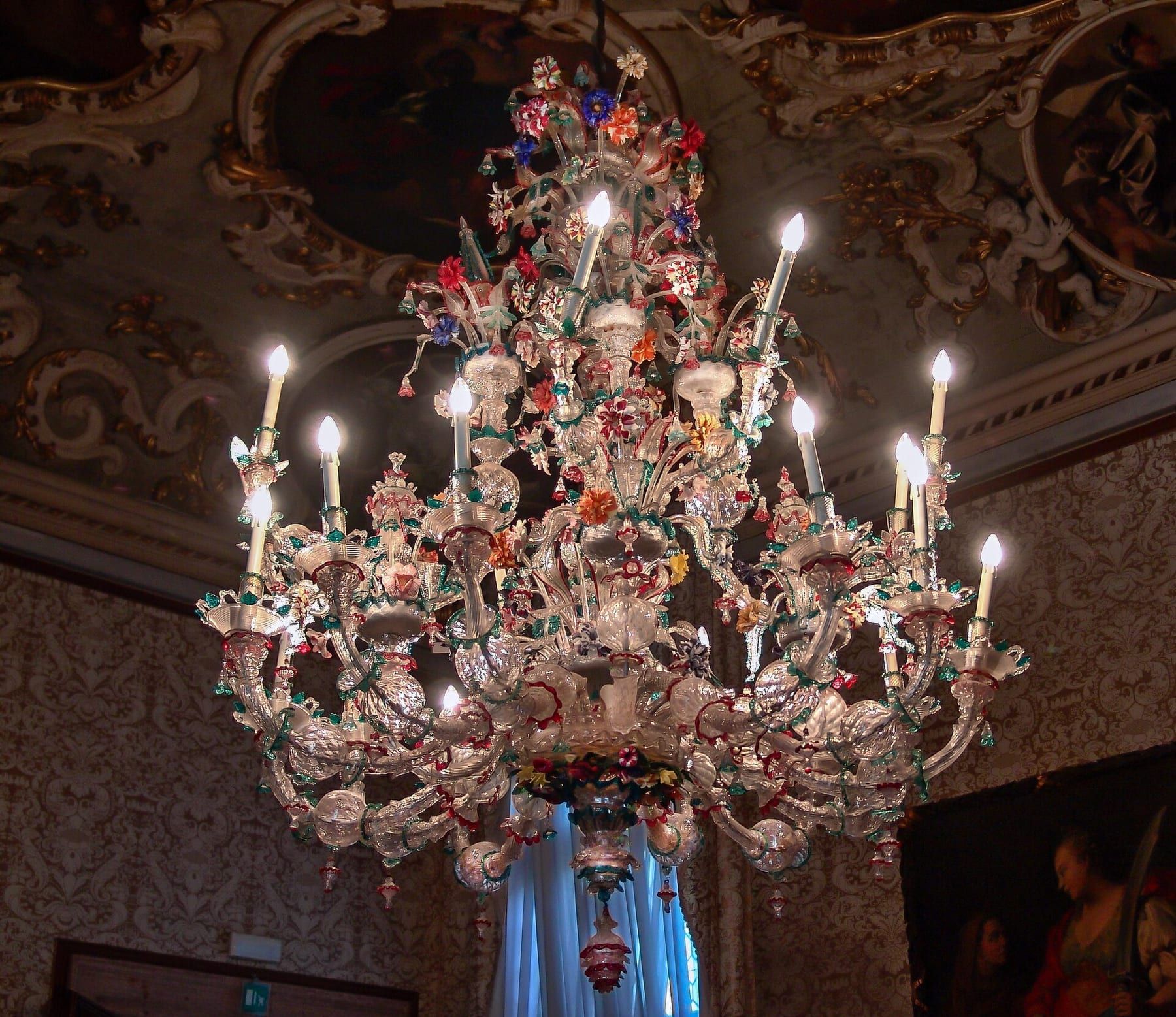
This is the century of the ciocca chandeliers, with flowers and leaves in coloured glass, of table services and mirrors. Venice lost its lead in clear crystal to Bohemia and answered with decorative imagination.
The nineteenth century: the revival
After the fall of the Republic in 1797, Murano’s furnaces went through a deep crisis. The section on 1850–1895 tells the story of the recovery: old techniques rediscovered, murrine and millefiori glass, a taste for copies of Renaissance models. It is also the story of how the museum itself was born.
Twentieth century and contemporary
Between 1900 and 1970 Murano glass became design: vases and lamps by artists and architects working with the big glassworks. The Spazio Conterie, devoted to contemporary work, shows recent pieces and temporary exhibitions, often with works donated by the island’s furnaces.
Venetian beads
One section is devoted to conterie, the tiny glass beads Venice exported across the world, as far as Africa and the Americas, and to lampwork beads. It is a less showy part of the museum, but it explains a lot about the lagoon’s economy.
History: an archive founded in 1861
The museum was founded in 1861, when Murano glass was trying to get back on its feet. The idea came from Antonio Colleoni, mayor of Murano, and Abbot Vincenzo Zanetti, a keen scholar of glassmaking: they persuaded the town council to set up an archive recording the island’s history. A year later Zanetti added a drawing school, where glassworkers studied on their days off, copying the old pieces on display.
In 1923 Murano was merged into the Comune di Venezia and the museum joined the Civic Museums. In the 1930s the collections were reorganised and grew with the Correr, Cicogna and Molin collections, which brought many Renaissance masterpieces to Murano. The museum still grows today through donations from the island’s glassworks.
Tradition says glassmaking was concentrated on Murano by the end of the thirteenth century, usually dated to 1291, to keep the fire risk of the furnaces away from the city. You will hear the story in every glassworks: whether or not every detail is true, it explains why all of Venice’s glassmaking know-how is still on this island.
Museum or furnace demonstration?
They are two different experiences and they complement each other. The museum shows you five centuries of masterpieces and explains the techniques. A furnace demonstration lets you watch a master glassmaker turn a drop of molten glass into a little horse or a vase in a few minutes. If you only have time for one and you care about art history, choose the museum; if you are travelling with children, the furnace will probably impress them more.
Price list compared
Live prices from our partner feeds, cheapest first. Tap a button to open the listing.
| Platform | Price | Rating | Duration | Book |
|---|---|---|---|---|
| Tiqets Murano: Glass Blowing Demo + Tour Best price | €10per person | ★ 4.5101 reviews | — | Book on Tiqets |
| Tiqets Murano: Glass Blowing Demo at the Glass Cathedral | €14per person | ★ 4.747 reviews | 30 min | Book on Tiqets |
Tiqets has two options:
- Demonstration at the Glass Cathedral (€14, about 30 minutes, free cancellation until the day before). It takes place in the former church of Santa Chiara, on Fondamenta Daniele Manin, now a working glassworks. You can buy afterwards, but you have paid for the ticket: you are there to watch, not to be steered into a shop.
- Glass-blowing demo + tour (€10, with a guide). A visit to a glassworks with a demonstration and free time in the shops. Read the listing carefully to see whether the boat transfer is included or whether you get to Murano on your own.
-
from €14 per person
Book on Tiqets -
from €10 per person
Book on Tiqets
If you would like a full guided day on the lagoon, the boat tours to Murano, Burano and Torcello almost always include a glassworks demonstration: you will find them on our page about the lagoon islands.
Beware of “free furnace” offers
Many glassworks run short demonstrations, usually 10–20 minutes long, some paid and some free. The free ones, and above all the “free” transfers sometimes offered around St Mark’s, pay for themselves through the showroom visit that follows, where the pressure to buy can be strong and prices are not always transparent. You are under no obligation to buy anything. Watch the demo, say thank you and leave: nobody will stop you.
How to recognise genuine Murano glass
The most reliable reference is the Vetro Artistico® Murano trademark, set up by Veneto Regional Law no. 70 of 1994 and owned by the Veneto Region. Only firms that produce on the island and follow a set of rules can use it; the list of authorised firms is published on the Region’s website. A few practical rules:
- a hand-blown goblet costs tens of euros, not small change: pieces at market-stall prices are almost always imported;
- ask for a certificate of origin and an invoice with the name of the glassworks;
- for shipping abroad, get the cost, delivery time and insurance in writing before you pay.
How to get to the Glass Museum
The museum is on Fondamenta Giustinian, in the north-east of Murano, near the basilica of Santi Maria e Donato. All ACTV lines to Murano cost €9.50 a ride (75-minute ticket); if you are also going to Burano the same day, the 24-hour pass at €25 is better value. Details on tickets and passes are on our ACTV vaporetto page.
| From | Line | Stop | Notes |
|---|---|---|---|
| Piazzale Roma or Ferrovia | 3 (direct) | Murano Museo | the fastest from the station |
| Piazzale Roma, Ferrovia, Fondamente Nove | 4.1 / 4.2 (circular) | Murano Museo | also stop at Colonna, Venier, Da Mula |
| San Zaccaria (St Mark’s) | 7 | Murano Navagero | about 24 minutes, then a few minutes on foot |
| Fondamente Nove | 12 | Murano Faro | 9 minutes; the same line continues to Burano |
On foot from Murano Faro. If you arrive on line 12 you get off beside the Murano lighthouse (faro), the white Istrian-stone tower that marks the island’s entrance from the lagoon. According to historical sources the present tower dates from 1934 and replaced an early twentieth-century metal structure; it is not open to visitors, but it is a good landmark for photos. From the lighthouse to the museum is about ten minutes’ walk along the fondamenta.
By water taxi. The Comune’s official fare from the historic centre to Murano is €60 per boat each way, and the same from the airport. If you are a group or have luggage, compare the options on taxi.venice.it.
Access fee. Murano is outside the access-fee area: the charge for day visitors applies to the historic centre, not the islands. All the rules are on our access fee page.
Practical tips for your visit
- Time: an hour and a half for the museum, half a day for Murano with a furnace and the church of Santi Maria e Donato, a full day if you add Burano and Torcello.
- Audio guide: included in the ticket through the MUVE app, available in Italian, English, French, Spanish, German and Korean. Bring earphones.
- Bags and luggage: backpacks and medium bags go to the free cloakroom. Suitcases and trolleys whose three sides add up to more than one metre are not allowed, so leave them at the hotel or a left-luggage office.
- Accessibility: the museum is accessible and has a lift. Murano has several stepped bridges, but you can reach Fondamenta Giustinian from the Museo stop without crossing one.
- Children: the chandeliers and coloured beads work well even with little ones; under-6s go free.
- Photos: check the signs in each room, especially in the temporary exhibitions in the Spazio Conterie, where the rules can differ.
What to combine with Murano
Next to the museum stands the basilica of Santi Maria e Donato, a twelfth-century Veneto-Byzantine church with a splendid mosaic floor, dated by sources to 1141, and a golden mosaic of the Madonna in the apse. Behind the altar hang large bones that legend attributes to a dragon slain by St Donatus: a detail children love.
From there, line 12 from Murano Faro takes you to Burano in just over half an hour, with its brightly painted fishermen’s houses and the Lace Museum, included in the Island Museums combo. If you still have time, carry on to Torcello. If you are heading back to the centre, line 4.1 or 4.2 takes you to Fondamente Nove, a short walk from Cannaregio. All our other ideas for the island, from furnaces to canal-side restaurants, are in the Murano guide.
Frequently asked questions
How much is a ticket to the Murano Glass Museum?
The official price is €15 full and €7.50 reduced for ages 6–14, students aged 15–25, over-65s and Rolling Venice or ISIC holders. Under-6s go free. On Tiqets the full ticket is also €15.
Is the Island Museums ticket worth it?
Yes, if you are also going to Burano or Torcello. It costs €20 (€10 reduced), is valid for 3 months and covers the Glass Museum, the Burano Lace Museum (€7) and the Torcello Museum (€7), which would cost €29 separately.
Can you watch glass-blowing inside the museum?
The museum shows the historic collection and explains the techniques, but to watch a master at work in front of the furnace you need a demonstration at a glassworks. On Tiqets the demo at the Glass Cathedral lasts about 30 minutes and costs €14.
Is the Glass Museum open on Mondays?
Yes, it opens every day: 10:00–18:00 from April to October and 10:00–17:00 from November to March. Last entry is one hour before closing.
How do I get to the Glass Museum from Venice?
Lines 3, 4.1 and 4.2 stop at Murano Museo, a few steps from the entrance. From St Mark's, line 7 runs from San Zaccaria to Murano Navagero, and from Fondamente Nove line 12 reaches Murano Faro in 9 minutes. A single ride costs €9.50.
How long does a visit take?
Allow about an hour and a half for the full route, from the archaeological section to contemporary glass. For half a day on Murano, add a furnace demonstration and the nearby church of Santi Maria e Donato.
How can I tell genuine Murano glass?
Look for the Vetro Artistico Murano trademark, created by a Veneto regional law and granted only to authorised firms, which the Region lists on its website. Be wary of very low prices and always ask for a certificate of origin.
Is the Glass Museum wheelchair accessible?
Yes. According to MUVE the museum is accessible and has a lift. Disabled visitors and one companion enter free, collecting their tickets at the desk.