Torcello and San Giorgio Maggiore sit at opposite ends of the lagoon and tell two different stories of Venice. Torcello, north beyond Burano, is the island where the city was born: one of the first communities in the lagoon, with a bishop, a port and a great basilica, later almost abandoned. What remains is a canal, a few houses, vegetable gardens and a church with Byzantine mosaics that are worth the trip on their own. San Giorgio Maggiore, by contrast, is the island you see across from St Mark’s Square: a Benedictine monastery with Palladio’s basilica, three minutes by vaporetto from San Zaccaria.
On this page you’ll find official tickets, hours and prices for both, how to reach them without boarding the wrong boat, and how to choose between the organised tours.
Torcello: why go
For centuries Torcello mattered more than Venice itself: a bishop’s seat, a trading centre, an island crowded with houses and churches. Silting canals and malaria slowly emptied it, and life moved towards Rialto. The result is a rare place where, a few minutes’ walk from a rural landing stage, you reach an early-medieval monumental complex.
Unlike Murano and Burano there are no shops and no crowds, except when the tours arrive. It is the island for lovers of Byzantine art, quiet places and the lagoon seen from above.
The basilica of Santa Maria Assunta
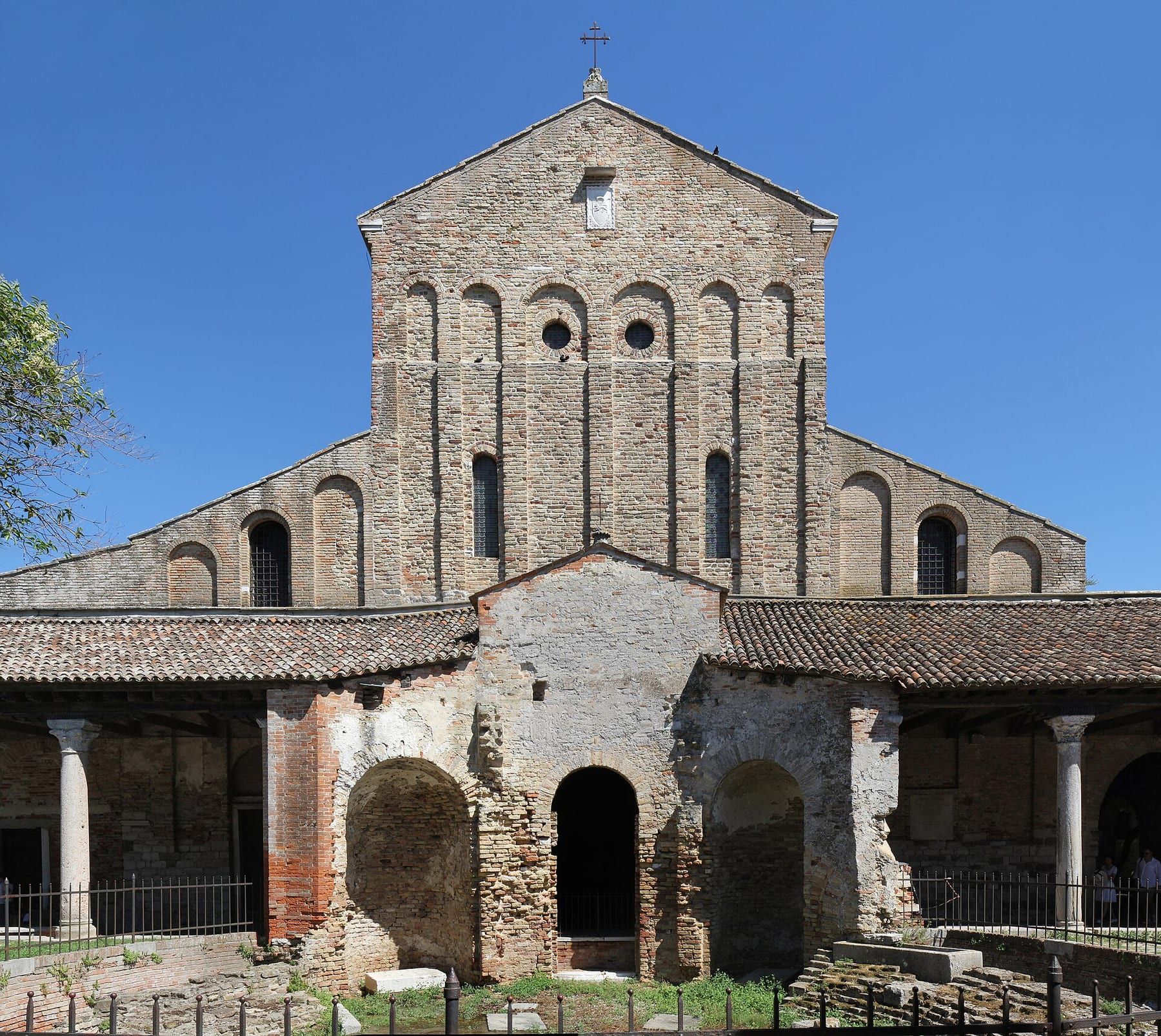
The basilica of Santa Maria Assunta, now run by the Patriarchate of Venice, was founded in 639 and is one of the oldest churches in the lagoon. The present building is the result of rebuilding between the 9th and 11th centuries, with the colonnaded portico in front of the façade and the remains of the round baptistery.
The Last Judgement
As you enter, turn around: the whole west wall is covered by the great Last Judgement mosaic, in Veneto-Byzantine style, made in several phases in the 11th and 12th centuries. It reads from top to bottom across six tiers: at the top the Crucifixion and the Descent into Limbo, then Christ in judgement between the Virgin, John the Baptist and the apostles, angels sounding trumpets and the dead rising, the weighing of souls, and at the bottom Paradise on one side and Hell on the other, with the damned sorted by their sins. It is one of the largest and most complete medieval Judgement mosaics you can see in Italy.
The apse and the rest of the church
At the opposite end, in the half-dome of the apse, is the Madonna Teotoca, the Virgin holding the Child, standing tall and slender against a gold ground with nothing else around her: an image that strikes precisely because of its solitude. Below her are the apostles. Look also at the marble floor, the iconostasis with carved panels and the bishop’s throne behind the altar.
The bell tower
Next to the basilica you can climb the square campanile: from the top you see the whole northern lagoon, Burano and its colours, Mazzorbo, the salt marshes and, on clear days, the Dolomites. The climb is on foot only; in summer the tower closes a little before the basilica.
Official hours and prices
| Basilica | Bell tower | Combined | |
|---|---|---|---|
| Full | €5 | €5 | €9 |
| Reduced | €4 | €4 | €8 |
| Hours 1 March–31 October | 10:30–18:00 (last entry 17:30) | 10:30–17:30 | — |
| Hours 1 November–end February | 10:00–17:00 (last entry 16:30) | 10:00–16:45 | — |
The audio guide costs €2. Free entry for children under 10, disabled visitors, guides and residents of the Patriarchate. Closed on 25 December and 1 January. These are the Patriarchate’s official prices when checked and can change; tickets are sold at the entrance, and there are no products for the basilica on Tiqets.
Santa Fosca, Attila’s Throne and the Devil’s Bridge
Beside the basilica, linked by the portico, stands Santa Fosca, an 11th–12th-century church on a central plan, wrapped by an octagonal portico: simple and harmonious, the perfect counterpoint to the scale of the cathedral.
On the grass between the churches and the museum is a stone chair everyone calls Attila’s Throne. Legend says the king of the Huns sat on it; more likely it was the seat of the magistrate or bishop who governed the island. Sitting on it for a photo is almost a ritual.
Along the canal from the landing stage to the centre of the island you cross the Devil’s Bridge (Ponte del Diavolo), a masonry bridge without parapets, as all Venetian bridges once were. The name comes from a local legend of a pact with the devil. Cross carefully, especially with children.
The Torcello Museum
The Torcello Museum has recently passed to the Fondazione Musei Civici di Venezia (MUVE). It occupies two buildings facing the square: the Palazzo dell’Archivio, with the archaeology section under an 11th–12th-century loggia, and the Gothic Palazzo del Consiglio of the 14th century, with the medieval section and picture gallery. Founded in 1870 on the initiative of Luigi Torelli and opened in 1889, it holds finds from the island and the lagoon, from Roman times to the Middle Ages, and fragments from churches that have disappeared.
| Ticket | Official price | On Tiqets |
|---|---|---|
| Torcello Museum | €7 · reduced €3.50 | €7 |
| Island Museums (Glass + Lace + Torcello, valid 3 months) | €20 · reduced €10 | — |
| MUVE Museum Pass (all Civic Museums, 6 months) | €50 · reduced €25 | — |
Hours: 1 April to 31 October 11:00–17:30 (last entry 16:30), 1 November to 31 March 11:00–17:00 (last entry 16:00). Closed on Mondays. On Tiqets the ticket costs the same as the official one, €7; the product is new and has no reviews yet. If you visit Murano and Burano on the same day, the Island Museums ticket at €20 beats three separate entries (€15 + €7 + €7 = €29). If you are also seeing the Doge’s Palace and the Correr, consider the MUVE Museum Pass: see the Venice passes page.
-
from €7 per person
Book on Tiqets
How to get to Torcello
This is where many people go wrong. Line 12, the one from Fondamente Nove to Burano, does not stop at Torcello during the day.
- Fondamente Nove → Burano on line 12: about 41 minutes, calling at Murano Faro and Mazzorbo. Daytime boats run every 20 minutes.
- Burano → Torcello on the line 9 shuttle, from the Burano “A” landing: 5 minutes, every 15 minutes from 9:30 to 17:45; back from Torcello from 9:40 to 17:55.
- From the Torcello landing, follow the canal on foot to the basilica: a short, flat walk, over the Devil’s Bridge.
Only the early-morning and evening line 12 runs stop at Torcello, and only on request: to board there, call ACTV on 800 845 065 at least 20 minutes ahead. Always check the current timetables on the ACTV website, because they change with the seasons.
A standard 75-minute ACTV ticket costs €9.50 and won’t cover the round trip: for a Burano and Torcello day the 24-hour pass at €25 is almost always better value. By water taxi the official fare from the historic centre to Burano or Torcello is €115, from the airport €140; for a quote there is taxi.venice.it. Torcello, like Murano and Burano, is not subject to the Access Fee.
Organised tours: when they make sense
“Three islands” tours leave from San Marco or Fondamente Nove, take you to Murano for a glass-blowing demonstration, then to Burano and Torcello, and bring you back to the city. They are convenient, but time on the island is short.
Price list compared
Live prices from our partner feeds, cheapest first. Tap a button to open the listing.
| Platform | Price | Rating | Duration | Book |
|---|---|---|---|---|
| Tiqets Murano, Burano & Torcello Tour + Glass-Blowing Demonstration Best price | €20per person | ★ 4.01,376 reviews | — | Book on Tiqets |
| Tiqets Murano, Burano & Torcello: Traditional Boat Tour + Glass-blowing Demonstration | €73.5per person | ★ 5.014 reviews | 5 h | Book on Tiqets |
- Murano, Burano and Torcello with glass demonstration, on Tiqets €20, rated 4.0 from more than 1,300 reviews: the cheapest way to see all three islands in half a day, but it usually allows 30–40 minutes on Torcello. Enough for the basilica, not for the bell tower and museum. Non-refundable.
- Traditional boat tour with glass demonstration, on Tiqets €73.50, 5 out of 5 but with few reviews: small groups and a wooden boat, with free cancellation up to the departure time.
If Torcello is your main goal, go on your own with a pass: you can arrive for the basilica’s 10:30 opening, climb the bell tower, see the museum and have lunch on the island before the groups.
San Giorgio Maggiore
The island of San Giorgio Maggiore faces the Molo di San Marco, separated from the Piazzetta by a stretch of the basin. It is taken up almost entirely by the Benedictine abbey, founded in 982, and Palladio’s basilica, whose white façade was completed after his death. Inside are two large canvases by Tintoretto in the chancel, the Last Supper and the Gathering of the Manna.
- Basilica: open every day 09:00–18:00. On Sundays Mass is at 11:00 in the Cappella della Deposizione.
- Bell tower: temporarily closed for extraordinary maintenance, with no reopening date. It was one of the best-loved viewpoints over the basin; check the abbey’s website before you go.
- Fondazione Giorgio Cini: guided visits, with a ticket office to the left of the basilica, take you into the monumental complex (cloisters, Longhena staircase, Palladian refectory), the Borges Labyrinth (a 1 km path among 3,200 box plants, about 45 minutes with audio guide) and the wood with the Vatican Chapels. Each visit costs €15 (reduced €13, children €5), two visits €22. During the summer schedule it is closed on Wednesdays.
On Tiqets the Borges Labyrinth costs €15, the same as at the ticket office, and can be cancelled up to the day before. For everything else about San Giorgio, the Salute and the Frari, see the San Giorgio, Salute and Frari churches page.
Getting there: line 2 from San Zaccaria, 3 minutes to the S. Giorgio stop. San Giorgio is part of the historic city: on days when the Access Fee is in force, the rule applies here too.
Practical tips
- Torcello in the morning: arrive for opening time, before the midday tours land.
- Shoes and mosquitoes: on Torcello you walk on dirt paths and grass, and in summer mosquitoes are plentiful.
- Eating: there are few restaurants on the island and they fill up with groups; alternatively, have lunch on Burano and come to Torcello in the afternoon.
- Dress: shoulders and knees covered in the churches.
- Accessibility: the Torcello bell tower can only be climbed on foot; the route from the landing to the basilica is flat but partly unpaved.
- San Giorgio at sunset: from the island’s shore you see the Doge’s Palace and the Piazzetta opposite in the evening light.
Combine with
- Burano and Murano: Torcello pairs naturally with Burano, five minutes away, and with Murano on the way back.
- Giudecca: from San Giorgio the same line 2 takes you to Giudecca in a few minutes.
- All the islands: a full comparison on the lagoon islands page.
Frequently asked questions
How do I get to Torcello?
Take line 12 from Fondamente Nove to Burano, about 41 minutes, then the line 9 shuttle, which reaches Torcello in 5 minutes, every 15 minutes from 9:30 to 17:45. During the day line 12 does not stop at Torcello: it calls there only early in the morning and in the evening, and only on request.
How much does the Torcello basilica cost?
The official ticket for the basilica of Santa Maria Assunta costs €5 (reduced €4), the same as the bell tower; the combined basilica and bell tower ticket costs €9 (reduced €8). The audio guide is €2 extra, and under-10s go in free.
What is there to see on Torcello?
The basilica of Santa Maria Assunta with its Last Judgement mosaic and the Madonna on a gold ground in the apse, the bell tower with its lagoon view, the church of Santa Fosca, the Torcello Museum, Attila's Throne and the Devil's Bridge with no parapets.
Is the Torcello Museum included in the Civic Museums tickets?
Yes. The museum is now run by the Fondazione Musei Civici di Venezia and is part of the Island Museums ticket (€20, with the Glass Museum and Lace Museum, valid three months) and the MUVE Museum Pass. On its own it costs €7, reduced €3.50, and it is closed on Mondays.
Are 'three islands' tours enough to see Torcello?
For a glimpse, yes; for a proper visit, no. The budget Murano, Burano and Torcello tours usually allow 30–40 minutes on the island, enough for the basilica but not for the bell tower and museum. If you want to see everything, go on your own with line 12 and the line 9 shuttle.
Can you climb the San Giorgio Maggiore bell tower?
Not at the moment: the San Giorgio Maggiore bell tower is temporarily closed for extraordinary maintenance, with no reopening date. The basilica remains open every day from 9:00 to 18:00.
How do I get to San Giorgio Maggiore?
On line 2 from San Zaccaria, a crossing of about 3 minutes to the S. Giorgio stop. The same line continues to Giudecca, so the two islands are easy to visit together.
Do Torcello and San Giorgio fall under the Access Fee?
Torcello does not: it is among the islands excluded from the fee. San Giorgio Maggiore is part of the historic city, so on charged days the same rule applies to day visitors as in the centre.